
Opinion
The Municipal Left Turn: Can They Govern?

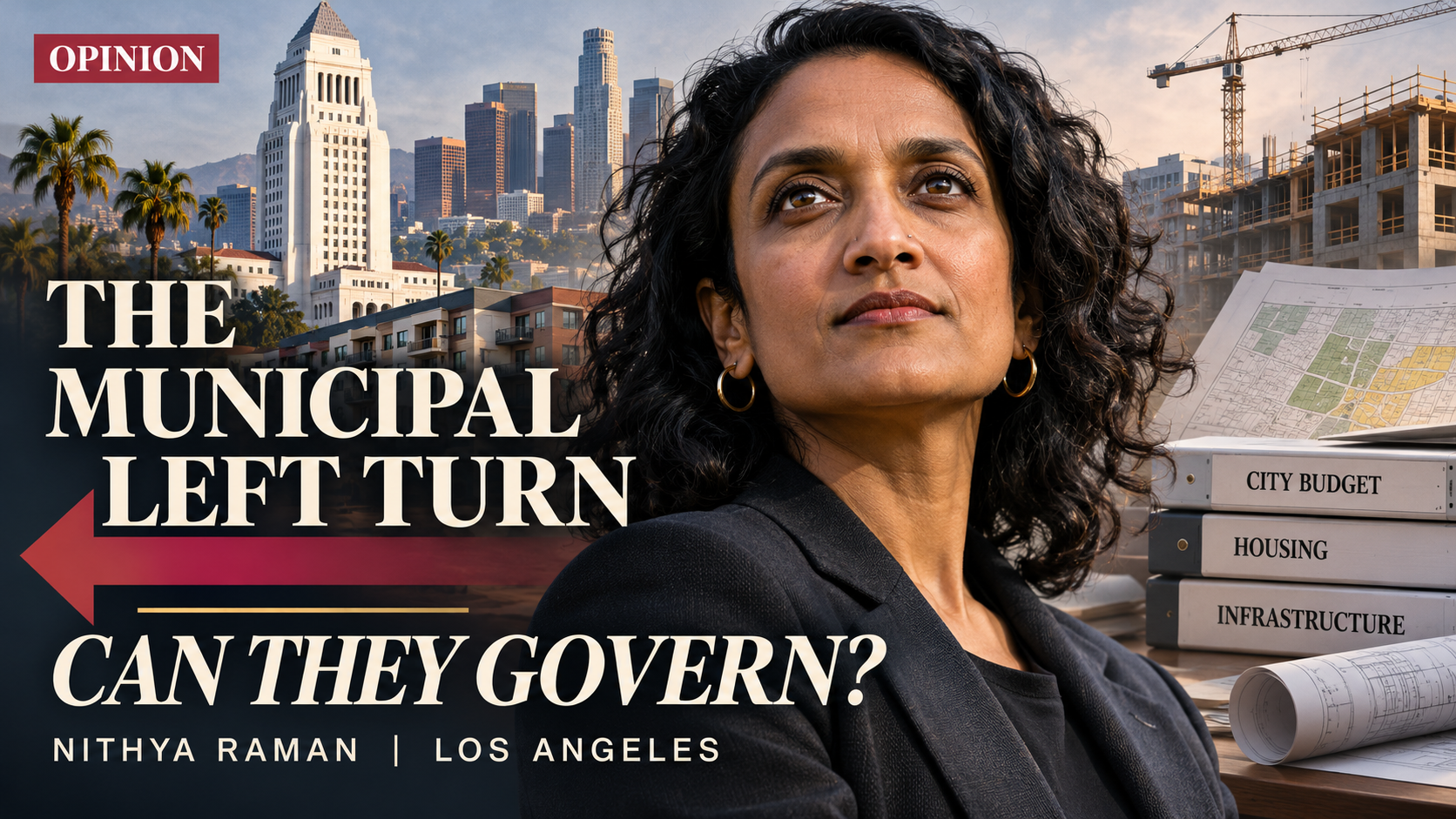
From Los Angeles to New York and Washington, democratic socialists are winning elections by promising a more affordable urban future. Their greatest challenge may be not defeating the political establishment, but succeeding where it failed.

For decades, democratic socialism in the United States was more often a language of protest than an exercise in executive power. Its advocates organized tenants, challenged corporate influence, protested economic inequality and demanded a greater public role in providing housing, transportation and social services. Winning control of America’s biggest cities, however, remained an ambition more than a governing reality.
That distinction is rapidly disappearing.
On November 5, Los Angeles City Council member Nithya Raman emerged victorious in her challenge to incumbent Mayor Karen Bass, becoming the first person of South Asian descent elected to lead America’s second-largest city. Her victory followed the election of Janeese Lewis George as Washington, D.C.’s next mayor on November 3 and the political breakthrough that brought Zohran Mamdani to New York City Hall in 2025.
Together, these victories suggest that a once-marginal political movement has become an increasingly credible contender for municipal power. Seattle, where democratic socialist Katie Wilson took office in January 2026, offers further evidence of the trend.
But the significance of this political moment lies in something more consequential than the electoral success of four left-wing politicians.
The American left is beginning to inherit the institutions it spent decades criticizing. It must now prove that its ideas can survive the demands of governing.
As Reuters reported following Raman’s victory, the Los Angeles result reflected widespread dissatisfaction with homelessness, housing affordability and the quality of public services. The election was not simply a referendum on socialism. It was a verdict on a municipal establishment that many voters no longer trusted to solve the problems closest to their daily lives.
That difference matters. Voters can embrace a radical promise without endorsing every aspect of the ideology behind it.
And a movement that mistakes public frustration for unlimited political permission risks repeating the failures of the establishment it has displaced.
Table of Contents
Los Angeles: The Revolt Against Municipal Incompetence
Nithya Raman’s victory represents one of the most remarkable reversals in contemporary Los Angeles politics.
Only months earlier, Raman had endorsed Karen Bass for reelection. She subsequently entered the contest shortly before the candidate-filing deadline, transforming what might have been a relatively conventional incumbent campaign into an unusually competitive referendum on City Hall.
Bass possessed nearly every institutional advantage associated with political incumbency. Her supporters included California Governor Gavin Newsom, former Vice President Kamala Harris and former House Speaker Nancy Pelosi. Her political career encompassed leadership in California’s legislature and service in Congress.
Yet those endorsements proved insufficient to overcome public dissatisfaction.
The Los Angeles Times reported on November 5 that Bass conceded after the vote count established Raman’s winning lead. Raman became the first challenger to defeat an incumbent Los Angeles mayor in more than two decades.
The Los Angeles County election returns remained unofficial as counting continued, making it premature to treat any interim percentage as the certified final margin.
Bass’s political difficulties had multiple causes. Los Angeles remained burdened by an immense homelessness crisis, persistent housing shortages and deteriorating public infrastructure. Her administration also faced criticism surrounding the response to the devastating January 2025 Southern California wildfires.
Raman’s campaign converted those frustrations into a broader argument: Los Angeles was not suffering solely from insufficient resources or political ambition. Its government had become too slow, fragmented and unresponsive to deliver improvements at the scale residents needed.
Her biography reinforced that message. An immigrant from India who studied at Harvard and MIT, Raman entered politics through urban planning and homelessness advocacy rather than a traditional party hierarchy. In 2020, she defeated incumbent Council member David Ryu, establishing herself as a representative of grassroots progressive organizing.
Her central promise was not merely redistribution. It was institutional transformation.
According to her campaign’s housing platform, Raman proposed tripling annual housing construction, reducing bureaucratic obstacles and expanding development across market-rate, subsidized and social housing.
That platform reveals an ideological complication often overlooked in national discussions of democratic socialism.
Raman is willing to challenge some regulatory and political assumptions traditionally associated with the urban left.
She has argued that excessive permitting delays, restrictive land-use rules and resistance to new development have helped make Los Angeles unaffordable. In a revealing break with some progressive allies, she supported efforts to reconsider aspects of the city’s so-called mansion tax when she believed they were discouraging apartment construction.
As LAist’s examination of the candidates’ housing policies explained, Raman differed from Bass on key questions about housing density near public transportation and restrictions on new residential development.
She is therefore not easily categorized as a conventional anti-market socialist.
Her political proposition is more complicated: government should protect vulnerable residents, but it must also allow enough housing to be built for the city to remain economically viable.
That combination may prove electorally powerful. Whether it can survive confrontation with neighborhood opposition, established interest groups and the realities of municipal finance is another question.
A Socialist Wave — But Not a Single Ideology
The rise of Raman, Mamdani and Lewis George invites comparisons, but treating them as politically interchangeable would obscure the more interesting story.
New York, Los Angeles and Washington have elected leaders with overlapping commitments to affordability, tenant rights and stronger public institutions. Yet their governing philosophies, institutional constraints and political constituencies differ substantially.
Mamdani entered office in January 2026 with promises to make New York more affordable through expanded child care, rent stabilisation and stronger public investment.
His administration has already produced measurable policy changes.
In June, New York’s Rent Guidelines Board adopted a freeze on permitted increases for covered rent-stabilized leases beginning October 1. The decision represented a significant political victory for tenants, although its longer-term effects on building maintenance and rental investment remain contested.
In August, the administration announced the elimination of remaining out-of-pocket child-care fees for approximately 22,000 eligible families already receiving subsidised care. This was a concrete expansion of affordability, not the completion of universal child care.
The distinction is essential. Municipal progress should be measured by policies implemented and services delivered, not by the scale of campaign promises.
Mamdani has also advanced a housing strategy targeting 200,000 new affordable homes over a decade. The proposal recognises that redistribution alone cannot resolve a housing crisis if supply remains chronically insufficient.
Washington presents a different political experiment.
Lewis George, a former prosecutor and council member, campaigned on affordable child care, tenant protections, stronger worker rights and the creation of 72,000 housing units.
Her victory was decisive, but her coming administration faces financial constraints that cannot be overcome through political enthusiasm alone.
As The Washington Post reported, Lewis George will inherit a capital confronting severe fiscal pressures, economic disruption linked to federal employment cuts and a complicated relationship with the federal government.
Unlike New York or Los Angeles, Washington operates under the District of Columbia’s distinctive home-rule system, leaving it vulnerable to forms of federal intervention that other municipal governments do not face.
The diversity of these circumstances undermines the suggestion that a unified socialist model is sweeping effortlessly across America.
What is emerging instead is a family of political experiments, united by dissatisfaction with the status quo but divided over methods, priorities and acceptable compromises.
Even Raman’s relationship with the Democratic Socialists of America has been complicated. As The Washington Post documented before the election, disputes over Israel, development policy and political independence created friction between Raman and sections of the movement.
Such tensions are not necessarily evidence of weakness.
They may be the unavoidable consequence of transitioning from ideological solidarity to the compromises required for governing a diverse city.
The Housing Contradiction at the Heart of the New Left
If there is one issue capable of determining the future of America’s municipal left, it is housing.
Housing has become the principal mechanism through which urban inequality reproduces itself. High rents undermine wage gains, restrict mobility, push young families away from employment centers and deepen social divisions.
The problem is national in scale.
Harvard University’s Joint Center for Housing Studies found in its 2026 State of the Nation’s Housing report that affordability pressures remained severe, with record levels of renter cost burdens and a continued shortage of homes affordable to lower-income households.
For years, progressive housing policy has emphasized rent protections, subsidies and public investment. Those measures can provide essential relief, particularly for people already living close to financial insecurity.
But they also raise a difficult question: Can cities protect existing tenants while simultaneously creating enough homes for future residents?
Rent stabilization without construction risks preserving scarcity. Construction without tenant protections can expose vulnerable communities to displacement. Subsidies without fiscal discipline can become increasingly expensive while leaving underlying shortages intact.
A durable housing strategy therefore requires more than one familiar ideological answer.
It requires reforming zoning and approval systems, expanding publicly supported housing, protecting tenants against arbitrary displacement, and finding workable partnerships with nonprofit and private developers.
Raman’s Los Angeles platform is especially revealing because it attempts to reconcile these often-competing priorities.
Her approach challenges both the idea that unrestricted property development will automatically generate affordability and the opposing assumption that stronger regulation alone can solve structural housing shortages.
Mamdani faces a similar challenge in New York, where the protection of rent-stabilized households must coexist with incentives to maintain existing buildings and increase supply.
Lewis George confronts it in Washington, where ambitious housing targets depend on investment in a city facing economic uncertainty.
For all three, the central question is whether affordability can become a measurable governing outcome rather than a permanent campaign slogan.
The Fiscal Reality That Campaigns Cannot Escape
There is a fundamental difference between promising that government will do more and proving that government can deliver more effectively.
The mayors emerging from the democratic socialist movement will confront that distinction almost immediately.
New York City adopted a fiscal 2027 budget of approximately $125.8 billion. Yet the city comptroller’s August assessment warned that unresolved structural fiscal pressures remained beneath the balanced annual budget.
Washington faces a different but equally demanding fiscal challenge. September 2026 revenue estimates projected weaker revenue in subsequent fiscal years, reflecting the economic effects of federal job losses.
Los Angeles has its own administrative problem: how to convert public appropriations into working programs.
The Los Angeles Times reported that the city underspent its homelessness budget by at least $473 million during fiscal 2025–26, with bureaucratic fragmentation, staffing shortages and delays among the contributing factors.
That failure illustrates a problem money alone cannot solve.
A city may commit substantial resources to homelessness while lacking the administrative systems needed to deploy them effectively. Agencies may work at cross-purposes. Contractors may be inadequately supervised. Housing projects may spend years navigating approvals. Residents may experience the resulting failures as evidence that government itself is incapable of improvement.
For a movement advocating a larger public role in social provision, administrative dysfunction carries a particular political danger.
If democratic socialists demand expanded government responsibility but cannot improve institutional capacity, their opponents will have a powerful argument against further expansion.
The practical test, therefore, is not simply how much money these administrations allocate to housing, transit or child care.
It is whether the money produces measurable improvements at sustainable cost.
That means transparent procurement, independent auditing, rigorous program evaluation and a willingness to discontinue initiatives that fail.
It also means acknowledging something difficult for any ideological movement: efficient administration is not a concession to centrism. It is a prerequisite for delivering progressive policy.
The Trump Factor: Resistance Meets Responsibility
The resurgence of democratic socialist municipal leadership is unfolding during Donald Trump’s second presidency, adding a national dimension to what would otherwise be local elections.
Immigration enforcement, federal funding, public safety and the boundaries of municipal authority have become central points of conflict between cities and Washington.
Raman campaigned on replacing Los Angeles Police Chief Jim McDonnell, criticizing what she regarded as inadequate separation between local policing and federal immigration enforcement.
Lewis George has similarly promised to end cooperation between Washington’s local police and federal immigration authorities in implementing the administration’s deportation agenda, according to The Washington Post’s election reporting.
These positions may reinforce support among voters worried about aggressive immigration enforcement. But mayoral resistance operates within legal and constitutional limits.
Cities cannot simply nullify federal law. They can, however, make decisions within the boundaries of their lawful authority about local resources, enforcement priorities and the protections available to residents.
That creates a delicate governing challenge.
The new mayors must defend their political commitments without allowing permanent confrontation with Washington to displace the basic obligations of municipal administration.
Mamdani’s experience suggests that ideological confrontation and practical negotiation need not be mutually exclusive. His administration has pursued progressive economic goals while also developing a less confrontational relationship with Trump than many anticipated.
For Raman, the challenge may be even more immediate.
Los Angeles is preparing to host the 2028 Olympic Games, a massive undertaking requiring coordination across multiple levels of government, extensive security planning and the management of substantial public expectations.
For Lewis George, the federal relationship is unavoidable by geography and law.
The political lesson is clear: resistance may help win an election, but governing requires knowing when to confront, when to negotiate and when to pursue incremental gains.
Beyond the Socialist Label: What Did Voters Actually Demand?
It would be tempting to interpret these electoral victories as evidence that millions of urban Americans have embraced democratic socialism as a comprehensive economic ideology.
That conclusion would go further than the available evidence supports.
The victories of Raman, Mamdani, Lewis George and Wilson demonstrate growing electoral receptiveness to candidates associated with democratic socialism. They do not establish that every voter who supported them endorses the movement’s broader ideological program.
Urban coalitions are rarely so uniform.
Some voters are committed socialists. Others are younger renters exhausted by housing costs. Some are labor organizers or immigrant-rights advocates. Others may be small-business owners frustrated by dysfunctional permitting, public disorder or municipal inefficiency.
Still others simply believe the incumbent establishment has had enough time to prove itself.
Raman’s campaign illustrates this political diversity particularly well. Her supporters included grassroots progressives, housing-development advocates and voters attracted to her promises of administrative reform.
Her success was not achieved by persuading every Angeleno to adopt the same political identity.
It came from assembling a coalition around practical grievances and the possibility of improvement.
That distinction should encourage the movement’s leaders to govern with intellectual flexibility rather than ideological triumphalism.
A successful administration will need to recognize when a market-based solution advances public welfare, when regulation is necessary and when direct public investment is indispensable.
It will also have to take opposition seriously. Residents concerned about taxes, public safety, development pressures or service quality are not necessarily enemies of social progress.
Democratic legitimacy requires answering their concerns, not dismissing them.
The more durable realignment may therefore be less a victory for socialism as doctrine than a transformation in what Americans expect from local government.
Cities are increasingly judged by whether ordinary people can afford to remain in them and whether public institutions can perform the functions for which residents pay taxes.
That demand can reward progressive candidates today. It can just as easily turn against them tomorrow.
The Real Revolution Begins After Election Night
The municipal left has reached a threshold that previous generations of American socialists could scarcely have imagined.
Its candidates have won some of the country’s most visible executive offices. They command substantial political attention, mobilize enthusiastic supporters and have an opportunity to demonstrate alternatives to conventional urban governance.
Yet the next phase of their political development will be less glamorous and far more consequential.
Raman will be judged by whether Los Angeles builds more homes, reduces street homelessness, restores confidence in city services and manages the Olympic preparations responsibly.
Mamdani will be judged by whether New Yorkers experience lasting affordability gains without a deterioration in housing quality, municipal services or financial stability.
Lewis George will be judged by whether Washington can expand opportunity while restoring economic confidence and protecting the city’s limited autonomy.
Wilson faces comparable pressures in Seattle.
None can permanently govern as an insurgent. Once elected, they become responsible for the institutions they once criticized.
This is the paradox of the municipal left’s success: winning power deprives it of the luxury of explaining every failure as somebody else’s responsibility.
America’s democratic socialists have demonstrated that they can organize, persuade and win elections. They have not yet demonstrated, across these cities and over a sustained period, that they can translate those victories into a superior model of urban government.
That is not a reason to dismiss their achievement. It is a reason to take it seriously.
The future of this movement will not be decided by the number of socialist mayors elected, the intensity of their campaign rhetoric or the enthusiasm of their supporters.
It will be decided in permitting offices, housing developments, school systems, budget negotiations, public-safety decisions and the ordinary encounters between citizens and city government.
The American left has won the right to govern. Its next task is to prove that it can make government work.
And that may be the most consequential political experiment now unfolding in America’s cities.
Discover more from The Monitor
Subscribe to get the latest posts sent to your email.



Can the new Congress challenge Trump’s immigration crackdown—or will election-night history meet the hard limits of presidential power?

On election night in Michigan, Abdul El-Sayed did more than hold a Senate seat for the Democrats. A 42-year-old physician and former public-health official, the American-born son of Egyptian immigrants became, according to media projections, the first Muslim ever elected to the United States Senate. The Republican he defeated, former congressman Mike Rogers, had questioned his political associations through allegations of extremist sympathies that El-Sayed denied and that Reuters reported were unsupported by evidence.
The result carried unmistakable symbolic weight. After months in which arguments about national identity and immigration enforcement filled American politics, a Muslim candidate won statewide office in a battleground that had twice supported Donald Trump for president. With about 97% of votes counted, El-Sayed led by seven percentage points, the Associated Press reported. Those are preliminary returns, not a certified final margin.
Yet the hardest question begins where the celebration ends. Can a senator-elect, even one whose victory expands the boundaries of political representation, alter the federal machinery that determines whether migrants are detained, deported, given a hearing—or returned to families? Or will the Democratic takeover of Congress produce televised confrontations while immigration agents continue to operate under presidential direction?
The midterms answered one question decisively: control of Congress can change. Whether the treatment of immigrants changes with it is a much more demanding test.
A breakthrough—though not a wave of immigrant-born senators
The distinction matters from the outset. El-Sayed is not an immigrant; he was born in Michigan to Egyptian immigrant parents. His win is a milestone for Muslim representation and for the children of immigrants, not evidence that large numbers of foreign-born candidates captured Senate seats. Reuters’ account of the reaction in Egypt illuminates both the significance of his heritage and the awkwardness of treating an American election as a victory belonging to another nation.
El-Sayed’s biography resists a single-issue reading. He trained as a physician, led Detroit’s health department, lost a Democratic gubernatorial primary in 2018, and returned with a campaign centered on affordability, corporate influence and Medicare for All. His opposition to unconditional American military support for Israel drew intense scrutiny; his Republican opponent argued that his views were too radical. CBS News’ examination of the campaign and the Associated Press’ post-election interview show a candidate who won by emphasizing economic discontent while also confronting attacks on his religion.
A candidate’s identity does not establish his entire agenda. On immigration, however, El-Sayed has made specific commitments. In an October interview with Michigan Public, he supported border security but called for abolishing ICE and replacing its approach with an enforcement and administrative system closer to the former Immigration and Naturalization Service. He criticized operations involving masked officers and argued that Congress had relinquished too much of its constitutional authority. His position is more sweeping than a demand for better body cameras or disciplinary proceedings: it would require Congress to redesign a federal agency.
The wider Senate class reveals a different pattern: an enlargement of political backgrounds, not a homogeneous immigrant caucus.
| Senator-elect | State | Verified political significance | Connection to immigration debate |
|---|---|---|---|
| Abdul El-Sayed (D) | Michigan | First Muslim elected to the Senate; U.S.-born son of Egyptian immigrants | Has called for replacing ICE and reforming immigration law |
| Peggy Flanagan (D) | Minnesota | First Native American woman elected to the Senate; member of the White Earth Nation | Represents an Indigenous political milestone, not an immigrant background |
| Juliana Stratton (D) | Illinois | Becomes part of a historic expansion of Black women’s Senate representation | Campaigned on abolishing ICE; not presented as immigrant-born |
| James Talarico (D) | Texas | Former teacher and state lawmaker; defeated Ken Paxton | Victory included a shift among Hispanic voters; his identity should not be conflated with immigrant status |
| Adam Hamilton (D) | Kansas | Methodist pastor who defeated Republican Roger Marshall | Stressed affordability and cross-party cooperation, illustrating motives beyond immigration |
| Josh Turek (D) | Iowa | Former Paralympian and state legislator who flipped a Republican-held seat | Disability representation and economic campaigning, not an immigrant-origin claim |
These election calls are drawn from Minnesota Public Radio, Axios’ Illinois reporting, AP’s Texas account, Reuters on Kansas and AP on Iowa. These are projected results pending the normal certification process; comparable final vote margins were not available for every race at this research cutoff.
The House contributes another part of the story. Muslim candidates reported as winners include New Jersey’s Adam Hamawy and New York’s Darializa Avila Chevalier alongside returning members such as Ilhan Omar and Rashida Tlaib, according to Dawn’s November 5 overview. This is an expansion of Muslim congressional representation across chambers, not a list of new senators. Nor should Muslim identity be used as a synonym for immigration status.
What the voters rejected—and what they did not
Democrats seized control of both chambers, including unexpected Senate gains in Texas, Kansas, Iowa, South Carolina, Maine, North Carolina and Ohio. As of the morning after the election, Reuters reported at least 54 Senate seats for the Democratic side, including allies, with some races unresolved. The Washington Post’s Senate results coverage documents the breadth of the shift.
It would nevertheless be a mistake to describe this as a referendum exclusively on deportations or anti-Muslim politics. A final Reuters/Ipsos survey of 1,765 adults found that 48% of registered voters named living costs as their leading consideration, versus 26% who named democratic norms and 13% who named immigration. That was a pre-election poll, not an exit poll proving why particular people voted as they did.
The more revealing finding is that immigration enforcement generated discontent without becoming the only, or even the principal, electoral issue. AP’s national Voter Poll, covering more than 100,000 voters, found roughly six in ten Hispanic voters supporting Democratic House candidates, a significant change from the coalition that backed Trump in 2024. In Texas, about six in ten Hispanic Senate voters supported Talarico, against approximately three in ten for Paxton. These are survey estimates for specific electorates and contests, not a census of all Hispanic Americans.
Economic and political factors overlapped. The Washington Post’s analysis of its voter survey found that voters focused on immigration and crime still tended to prefer Republicans. A party can therefore lose an election without the country rejecting every element of its immigration platform. Discontent over the Iran war, gasoline prices, tariffs, health care and government accountability was also central to the result.
A further correction is essential: most immigrants cannot vote unless they have become U.S. citizens. Many Hispanic voters were born in the United States, while naturalized citizens come from every region of the world. A Congressional Research Service demographic briefing updated in September 2026 estimated 50.2 million foreign-born U.S. residents in 2024, including approximately 25.8 million naturalized citizens. Calling the midterms an “immigrant vote” without distinguishing citizenship, ancestry and ethnicity would obscure the very communities the description claims to represent.
The more defensible interpretation is that Americans assembled several forms of dissatisfaction into one electoral outcome. Identity mattered in Michigan. Enforcement tactics mattered in places touched by raids. Prices mattered almost everywhere. A national coalition won; its individual members did not necessarily vote for the same immigration reforms.
The enforcement record Congress inherits
The Trump administration’s argument is that vigorous enforcement protects public safety, restores the integrity of immigration law and deters unauthorized entry. Its supporters point to reduced unlawful border crossings and an expanded capacity to arrest and remove people subject to immigration proceedings. A pre-election AP examination of the crackdown reported both the border-security achievements claimed by the administration and the growing backlash against enforcement encounters inside American communities.
But border management and interior enforcement are distinct enterprises. The question is not simply whether a government may enforce immigration law—it may—but what procedures govern encounters, whether people can contest removal and what happens when officers make mistakes.
The restrictions extend beyond undocumented migrants. In January 2026, the administration expanded entry and visa restrictions affecting nationals of 39 countries and holders of Palestinian Authority travel documents, with category-specific exceptions. The State Department’s own guidance explains the restrictions as national-security screening. Many affected countries are Muslim-majority, but not all are; critics characterize the policy as discriminatory in design or effect. A serious legal assessment must identify the actual rule, its exceptions and the evidence for any allegation of religious discrimination rather than assume that nationality and religion are interchangeable.
Courts have not delivered a uniform verdict in immigration cases. In June, the Supreme Court rejected the administration’s broad effort to limit birthright citizenship under the Fourteenth Amendment, Reuters reported. Yet in September the same court permitted third-country deportations to resume while it considers the underlying litigation, according to Reuters. The administration argues that such transfers help remove people, including those with criminal convictions; challengers contend that migrants must be able to raise credible fears of persecution or torture before removal to an unfamiliar country. An interim court order allowing a practice to proceed is not a final determination that every application is lawful.
The consequences are immediate, not theoretical. On November 4, AP reported a federal judge’s temporary order restricting deportations of detained Afghans to Afghanistan or Pakistan after warnings about persecution risks. The case illustrates why due process has practical importance even when there is broad public support for border control: a removal decision may be irreversible long before the legal dispute is resolved.
Economic consequences also resist easy slogans. Pew Research Center estimates show that immigrants have become a substantial part of the U.S. workforce. Their participation varies across sectors and legal categories. Enforcement can reduce exploitation where unlawful employment is addressed, but indiscriminate disruptions may also impose costs on employers, workers and communities. Evaluating policy therefore requires both border and workplace data, not only arrest totals.
Three deaths, and a larger question about accountability
The killing of Lorenzo Salgado Araujo in Houston on July 7 exposes the risks of viewing every enforcement encounter solely through an immigration-status lens. The 52-year-old Mexican national was shot by an ICE officer during an attempted vehicle stop. DHS said he tried to ram an officer and that the shooting was in self-defense. His family disputed the official description. Crucially, DHS later acknowledged the officers had been seeking someone else and stopped Araujo because he resembled their target, according to AP reporting.
Agents involved were not wearing body cameras, Houston Public Media reported. Investigations were opened, and the family’s demand for an independent account remained separate from DHS’s assertion of justification. The medical examiner’s designation of a death as homicide, where applicable, is a classification of how a person died—not a criminal judgment that an officer committed murder.
Two killings in Minneapolis earlier in 2026 raised related but different questions. On January 7, ICE officer gunfire killed Renee Good, a U.S. citizen, during a vehicle encounter. Administration officials described the shooting as self-defense; AP’s examination documented video evidence, public disagreement and ongoing investigations. On January 24, federal Border Patrol agents killed Alex Pretti, also a U.S. citizen and an intensive-care nurse. The government’s initial account said he approached with a handgun; Reuters’ review of bystander video raised significant questions about the sequence of events. FactCheck.org’s analysis likewise identified claims unsupported or apparently contradicted by available footage, while warning that the investigation was incomplete.
Good and Pretti were not immigrants. Their deaths belong in this article because they arose from federal immigration operations and intensified debate about officer identification, use-of-force rules, incident reporting and independent review. Conflating their deaths with migrant fatalities would weaken the accuracy of that debate.
Deaths in detention constitute another category entirely. In June, a Reuters investigation found 50 deaths in immigration detention since January 2025 and estimated that the annualized death rate relative to the average detained population had more than doubled compared with its 2009–2024 benchmark. In September, Bloomberg Law reported 37 deaths in ICE detention during the fiscal year then ending. The figures refer to different time windows; they must not be added together.
The Department of Homeland Security has disputed claims of a rising death rate and says it maintains a high standard of medical care, as Reuters reported in June. Experts caution that illnesses, suicide, age and changing detainee populations complicate direct causal attribution. Yet complications are precisely why transparent mortality data, medical reviews and independent inspections matter. AP’s investigation into suicides in custody identified apparent shortcomings in mental-health screening and monitoring, while DHS defended its care standards.
Neither a tragic outcome nor a disputed video automatically establishes a criminal offence. Equally, invoking self-defense cannot substitute for an evidence-based investigation. The institutional question is whether investigators can obtain records, witness testimony and usable video without relying wholly on the agency whose personnel are under scrutiny.
The Senate can investigate; it cannot govern by investigation alone
The election substantially changes the machinery of oversight. Democratic chairpersons can schedule hearings, seek documents and, under committee procedures, pursue subpoenas. They can examine hiring and training standards, deaths in custody, the handling of medical emergencies, body-camera compliance, contracts with detention operators and the chain of command after fatal incidents. The Senate’s own description of investigative powers makes clear that inquiry is an established element of congressional responsibility, while its committee guidance distinguishes investigative, legislative and confirmation hearings.
Those powers are not personal prerogatives of a senator-elect. A single member can demand answers and organize public attention; enforceable congressional subpoenas ordinarily depend on authority delegated to a chamber or committee. The Justice Department’s published legal analysis makes that distinction explicit. Incoming members usually begin regular terms on January 3, 2027. They cannot simply command ICE officers in November.
The Senate can also refuse to confirm certain executive and judicial nominees, compel administration officials to defend their policies in public and consider statutory changes to detention conditions or the handling of administrative appeals. But replacing ICE, as El-Sayed advocates, would require legislation, institutional redesign, agreement over who conducts enforcement and sufficient votes. Oversight may expose violations; investigations do not themselves rewrite immigration law.
Control of both houses adds another lever: the power of the purse. There is an important catch. Congress already enacted substantial multiyear border and immigration-enforcement funding in 2026. A Congressional Research Service summary of FY2027 appropriations notes that ICE and Border Patrol continue to draw on resources from a reconciliation measure rather than relying entirely on annual appropriations. The Congressional Budget Office puts that 2026 reconciliation funding at $70 billion for those operations.
That financing limits any simple strategy of withholding next year’s regular ICE appropriation. Rescinding already enacted funds or changing the governing statutes generally requires another law, and therefore must confront the president’s signature or veto. Congress can still seek records, attach conditions to legislation that can pass, examine contracts, and make the political and administrative costs of opaque enforcement more visible.
Here the difference between protest and policy becomes evident. An investigation that identifies a broken procedure can produce a public record. A committee proposal can translate that record into a specific standard. A negotiated law can give that standard force. Each stage needs a different coalition and faces different resistance.
Trump’s veto is powerful, but it is not a universal shield
Trump has signaled that he intends to use the veto. He told CBS News in an election-day interview that it was his ultimate weapon against a Democratic Congress; after the results he publicly displayed a hat bearing the word “VETO,” as The Wall Street Journal reported.
Article I of the Constitution enables Congress to override a veto only with two-thirds of members voting in each chamber, provided a quorum is present. The Congressional Research Service’s January 2026 guide explains the mechanism. Democrats’ projected majorities are not by themselves veto-proof. Normal Senate rules, including the filibuster for most legislation, create further barriers well before a bill reaches the president’s desk.
But the veto is not authority to erase court rulings, cancel congressional investigations or prevent every request for documents. Nor does it let a president create funds that Congress has not lawfully provided. Executive discretion remains considerable, particularly over enforcement priorities and agency leadership, but it operates within statutory and constitutional limits. Court disputes may be prolonged; they are not resolved by a presidential slogan.
The next two years could therefore feature confrontation without automatic policy reversal. Hearings can focus attention on detention deaths and fatal force; judges can decide individual procedural claims; agencies can continue enforcing existing law; lawmakers can seek compromise on medical-care standards, reporting requirements and transparent identification. The administration’s security case deserves scrutiny against measurable outcomes, while critics’ allegations deserve testing against records rather than repetition as settled fact.
The three paths from 2027 to 2028
One path is sustained institutional conflict. Congressional committees summon DHS leaders, request operational files and dispute appropriations; the administration resists requests it considers intrusive or politically motivated. Such conflict could clarify facts, but prolonged litigation and legislative stalemate may limit immediate relief for affected families.
Another is selective negotiation. Legislators who disagree about deportation targets might nevertheless find common ground on body cameras, death reporting, credible-fear procedures, healthcare inspections or clear rules for encounters with the public. Even modest agreement would require the White House and both chambers to accept detailed, enforceable provisions. The electoral coalition itself gives no guarantee of that bargain.
A third is administrative continuity amid intensified scrutiny. Existing funding sustains operations, the president vetoes major restructuring and courts address discrete disputes as they arise. Under this path, a new Congress could alter public understanding and agency behavior without achieving the broader reforms some of its members seek.
These are institutional possibilities, not predictions. Their shape will depend on legislators’ priorities, committee assignments, executive responses, judicial decisions and public evidence yet to emerge. None should be assigned a numerical probability merely to make the analysis appear scientific.
A historic seat is not the same as a protected home
The symbolic meaning of El-Sayed’s election is substantial precisely because American citizenship, religious belonging and access to power have long been contested subjects. But symbolic representation and legal protection operate on different calendars. One changes with a ballot count; the other may depend on a detention decision made before dawn, a lawyer securing access to a client, or an officer recording a use of force.
The newly elected senators represent different constituencies and different political ideas. A Muslim senator may advocate ending ICE. A Native American senator may approach state power through the history of sovereignty and dispossession. A Black woman senator may draw on experience in law and government. A pastor from Kansas or a teacher from Texas may emphasize affordability, public accountability or negotiated enforcement. None should be presumed to speak for an entire community, and the people affected by immigration policy are neither uniformly Democratic nor uniformly opposed to deportation.
There is also a danger in imagining that the election has lifted all fears. The Washington Post reported that voting itself proceeded broadly smoothly, despite pre-election concern about federal interference. That civic success does not resolve the status of asylum seekers, undocumented workers, lawful residents confronting travel restrictions or families divided by detention.
America’s midterms produced a visible change in who holds congressional power. They did not transfer control of federal immigration agencies to the opposition party, invalidate existing statutes or repeal money already appropriated. They created oversight opportunities and raised the political cost of unchecked assertions, while leaving substantial executive discretion intact.
That is the central distinction between an electoral milestone and governing change. El-Sayed’s arrival will show that a Muslim American can win a statewide Senate contest despite attacks connected to his faith. What the next Congress does with subpoenas, nominations, appropriations and legislative negotiations will show whether a historic increase in representation produces more reliable rules for the millions of people who live under immigration law. The answer will not be found in a victory speech. It will be found in the public record of the next two years.
Discover more from The Monitor
Subscribe to get the latest posts sent to your email.

President Donald Trump said Tuesday that the United States will end its roughly $4 billion in annual funding to Israel by the close of this year under an agreement he reached months ago with Israeli Prime Minister Benjamin Netanyahu.
Speaking by phone on Fox News’ Fox & Friends as Americans voted in the midterm elections, Trump stated that the two leaders had decided to halt the payments because Israel “doesn’t need it” and to remove what he described as a damaging political talking point used by critics.
“Now, as far as paying Israel, Bibi Netanyahu and I have made a deal that we give Israel $4 billion a year, and we made a deal months ago that we’re stopping,” Trump said. “We’ve already agreed that by the end of this year we won’t be paying Israel. Now, we’ll help Israel if they need it.”
Trump added that Netanyahu had raised the idea himself, saying the Israeli leader told him it would be “appropriate” not to receive the aid given domestic political controversy in the United States. He specifically referenced criticism from Democratic Michigan Senate candidate Abdul El-Sayed and others on the left, calling continued payments “a bad talking point”.
The announcement immediately raised questions about implementation. The current U.S.-Israel Memorandum of Understanding, which provides about $3.8 billion annually in military assistance, does not expire until 2028. U.S. military aid to Israel is appropriated by Congress, and experts noted that abrupt termination of ongoing programs—particularly in missile defense and counter-drone systems—would face legal and logistical hurdles. Trump has not detailed the precise mechanism or timeline for ending the funding.
There was no immediate confirmation from Netanyahu’s office or Israel’s foreign ministry. Israeli defense and financial officials were reportedly caught off guard by the public statement. The U.S. State Department did not respond to requests for comment.
The move comes amid declining American public support for unconditional aid to Israel since the war in Gaza that began in 2023. A recent Quinnipiac University poll found that nearly half of U.S. voters overall, and two-thirds of Democrats, believe the United States is too supportive of Israel. Aid to Israel has also become a point of contention within the Republican Party, drawing criticism from some isolationist and “America First” voices.
Trump framed the decision as consistent with a strong alliance, emphasising that the U.S. would continue to support Israel “if they need it” and that Israel remains a key partner. He noted that Israel could still purchase American weapons.
Analysts described the timing—on Election Day—as potentially aimed at neutralising attacks from both progressive Democrats and some within the MAGA coalition. Former Republican Rep. Marjorie Taylor Greene wrote on X that the announcement was unlikely to change midterm results, while others questioned whether the pledge would hold after the election.
The development marks a significant rhetorical shift in a relationship that has included steady U.S. military financing for decades. Whether the stated cutoff materialises by the end of 2026, and in what form, remains unclear pending further details from the White House and any formal agreement with Israel.
References
Al Jazeera. (2026, November 3). Trump says US will stop giving Israel aid after year-end. https://www.aljazeera.com/news/2026/11/3/trump-announces-that-us-will-stop-paying-israel-after-year-end
Debusmann, B., Jr. (2026, November 3). Trump says US ‘won’t be paying Israel’ by end of year. BBC News. https://www.bbc.co.uk/news/articles/cmx2dlx86n9yo
Reuters. (2026, November 3). Trump says US will stop $4 billion in funding to Israel at end of 2026. https://www.reuters.com/world/middle-east/trump-says-us-will-stop-paying-israel-after-year-end-2026-11-03/
Times of Israel. (2026, November 3). Trump says US to end $4 billion in annual military aid to Israel by end of 2026. https://www.timesofisrael.com/trump-says-us-to-end-4-billion-in-annual-military-aid-to-israel-by-end-of-2026/
Discover more from The Monitor
Subscribe to get the latest posts sent to your email.

Three headlines about Elon Musk’s companies appeared to tell unrelated stories: a spectacular electric sports car, a possible corporate merger and growing dependence on satellite connectivity. Read together, they reveal a broader contest over capital, engineering and control of digital infrastructure.
The key is to separate announcements, proposals and operational results. A demonstrated vehicle capability is not a mass-production date. A corporate committee is not a completed merger. And satellite coverage is not the same as unrestricted service under every political or security condition.
Tesla Roadster: the spectacle and the schedule
Reuters reported in mid-October on a next-generation Tesla Roadster demonstration involving SpaceX-inspired thruster technology. The report also indicated that customer deliveries would not begin until 2028. The distinction between a prototype showcase and a product ready for buyers is the most important one for readers evaluating Tesla’s technology ambitions.
A dramatic unveiling can demonstrate engineering intent. What follows is less glamorous: homologation, manufacturing readiness, servicing plans, warranty commitments, cost control and repeatable performance in ordinary conditions. Prospective buyers should not treat estimated specifications or on-stage promises as final contract terms.
SpaceX–Tesla merger talks: possible is not agreed
Reuters reported on October 22 that a potential merger would require Musk’s approval, even as governance considerations complicated the discussion. Committees studying a deal have not, by themselves, established a price, transaction structure, regulatory clearance or shareholder outcome.
The strategic case is obvious to enthusiasts: electric vehicles, robotics, satellites, artificial intelligence and computing capacity might be marketed as a single integrated ecosystem. The drawbacks are equally serious. A conglomerate can obscure business-level performance, increase capital-allocation conflicts and make valuation harder. Directors and shareholders would need to scrutinise related-party interests and who benefits from any exchange ratio.
The less cinematic AI numbers
Reuters’ October earnings coverage described rapid revenue growth in SpaceX’s AI business alongside a sharp increase in capital spending. Investors should resist both extremes: dismissing all AI demand as hype or assuming revenue growth guarantees attractive free cash flow. Data-centre infrastructure needs chips, sites, power and expensive maintenance.
Fast revenue growth can coexist with high valuation risk. The test is whether new businesses eventually finance their own expansion while preserving adequate returns to capital providers.
Starlink’s national-security dilemma
Satellite networks promise resilience when terrestrial networks fail. They also create dependence on operators with technical control over service policies, access and availability. October reporting on Starlink and Ukraine highlighted how restrictions or changes in operational capability can acquire strategic significance. The Reuters account noted statements by Ukrainian officials about restored connectivity at high travel speeds; statements about the causes of earlier restrictions require careful attribution.
For governments and businesses, diversification may therefore matter almost as much as signal quality. Critical communications need backups, clear contracts and a plan for service interruption.
Five questions before believing the next Musk headline
| Claim | Verification test |
|---|---|
| A rocket or vehicle can perform a feat | Independent evidence of a completed demonstration |
| A car launches next year | Confirmed production, approvals and delivery schedule |
| Two companies are merging | Filed agreement, board and shareholder approvals |
| AI business is profitable | Cash flow, costs and credible segment disclosure |
| Satellite service is universally available | Licence, coverage, capacity and contractual terms |
Why the story matters outside the US
Pakistan and other emerging markets look to satellite broadband, low-cost electric technology and AI tools for development opportunities. They also face affordability, spectrum and regulatory questions. Importing a futuristic product is not a substitute for competition policy or infrastructure resilience.
Corporate governance will matter as much as engineering
A potential deal between companies closely associated with the same entrepreneur raises questions about valuation, conflicts and decision-making. Independent directors must consider whether each shareholder group receives fair treatment; enthusiasm for a shared brand is not a substitute for transaction terms. Investors should distinguish a serious formal proposal from a public comment about strategic possibilities.
There is also a different risk profile across the businesses involved. A vehicle manufacturer faces factory utilisation, safety recalls and consumer financing. A satellite operator depends on launch capabilities, spectrum arrangements, recurring subscriptions and government permissions. AI computing infrastructure adds yet another profile involving power costs, hardware replacement and contract concentration. Combining these enterprises does not make their underlying risks disappear.
For followers of the space programme, the next meaningful milestone is evidence of repeated operational success, not a promise that a future mission will use advanced recovery methods. For EV buyers, it is a firm delivery programme with defined specifications. For connectivity users, it is consistent service under known contractual conditions.
A restrained technology roundup can celebrate ambitious engineering while continuing to ask ordinary questions about reliability, costs and the institutions that oversee it.
Are Tesla and SpaceX already one company?
No. Reported discussions and committees do not establish a completed merger.
Does a Roadster prototype guarantee 2028 deliveries?
No. The announced timeline remains subject to production and regulatory realities.
Can Starlink replace every terrestrial telecom network?
No. It may be particularly valuable in hard-to-serve areas or emergencies, but capacity, cost and regulation still matter.
The overlooked theme: Musk’s ventures are increasingly connected by shared ambitions and capital demands. The more compelling editorial question is not what they can announce, but which promises can be delivered at scale and at a defensible cost.
Discover more from The Monitor
Subscribe to get the latest posts sent to your email.

The Municipal Left Turn: Can They Govern?

The First Muslim Senator and the Limits of America’s Midterm Revolt

Trump Announces U.S. Will Stop $4 Billion Annual Aid to Israel by End of 2026

What Is Trump Doing on Election Day 2026? Inside His White House Plans

Tesla, SpaceX and Starlink: The Real Business Story Behind Elon Musk’s October Buzz

Resilience Under Strain: The World’s Difficult 2026 Choices

Andy Harris in 2026: Freedom Caucus Influence, Spending and Congressional Power

MLB Playoffs 2026: Postseason Format, Broadcast Guide and How to Track the Bracket

Elon Musk Calls Mukesh Ambani the “Real Boss of India” Over Alleged Monopoly Concerns

Inside the Modern Republican Party Platform: Tax Policy, Immigration, and Governance

Analyzing the Republican Voter Enthusiasm Gap: Turnout Metrics and Polling Data
What Is Trump Doing on Election Day 2026? Inside His White House Plans
Resilience Under Strain: The World’s Difficult 2026 Choices

Anne Carson: Genius of Hybrid Forms and 2026 Nobel Laureate in Literature
Elon Musk Calls Mukesh Ambani the “Real Boss of India” Over Alleged Monopoly Concerns
Trump Announces U.S. Will Stop $4 Billion Annual Aid to Israel by End of 2026
MLB Playoffs 2026: Postseason Format, Broadcast Guide and How to Track the Bracket
Andy Harris in 2026: Freedom Caucus Influence, Spending and Congressional Power
-

 Featured6 years ago
The Right-Wing Politics in United States & The Capitol Hill Mayhem
-

 Conflict5 years ago
Kashmir Lockdown, UNGA & Thereafter
-

 News5 years ago
Prioritizing health & education most effective way to improve socio-economic status: President
-

 China5 years ago
Coronavirus Pandemic and Global Response
-

 Democracy5 years ago
Missing You! SPSC
-

 Digital6 years ago
Pakistan Moves Closer to Train One Million Youth with Digital Skills
-

 Canada5 years ago
Socio-Economic Implications of Canadian Border Closure With U.S
-
Democracy5 years ago
President Dr Arif Alvi Confers Civil Awards on Independence Day