
Corruption
Transparency International Pakistan releases NCPS 2025

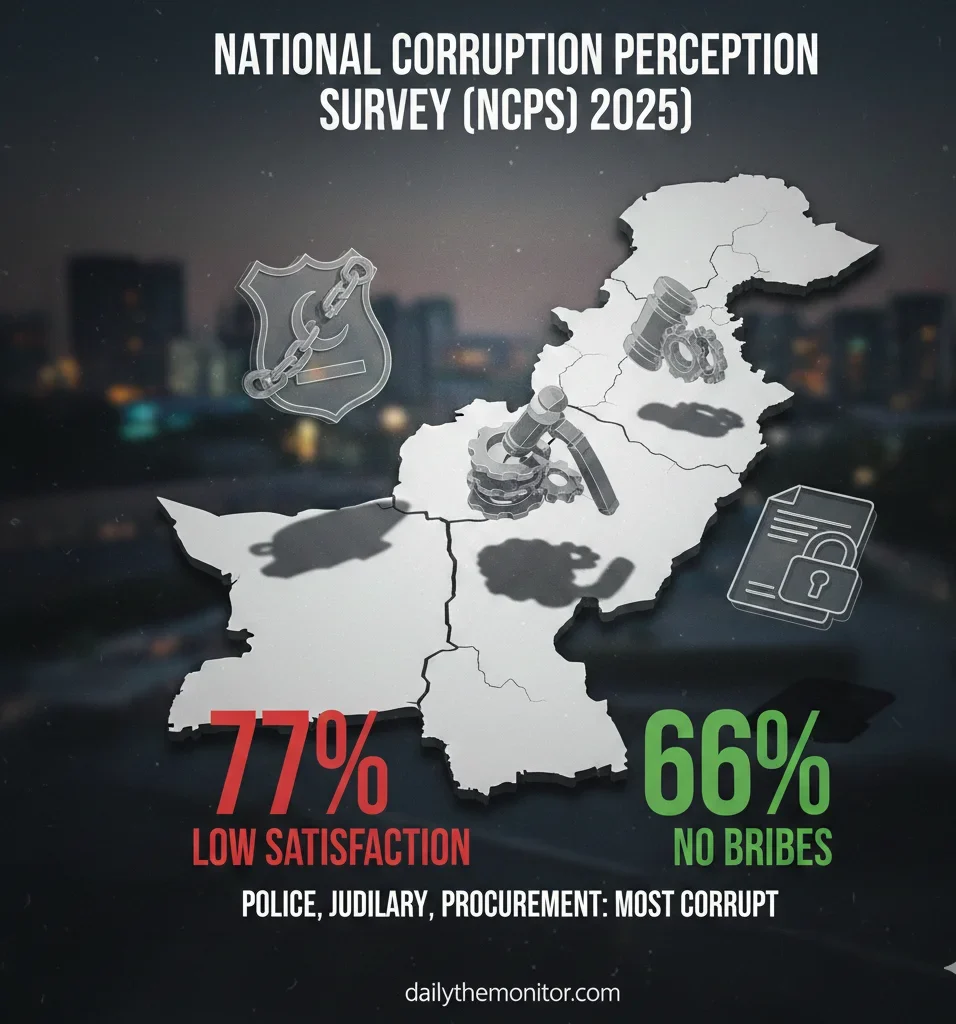
ISLAMABAD—Transparency International Pakistan (TIP) on Tuesday released its comprehensive National Corruption Perception Survey (NCPS) 2025, presenting a mixed picture of public sentiment on corruption, anti-graft efforts, and governance across the country.
The survey, conducted with 4,000 respondents from all four provinces, reveals that while a significant majority of citizens did not report paying a bribe in the last year, three key public sectors—the Police, Tender/Procurement, and the Judiciary—continue to be perceived as the most corruption-prone institutions.
Table of Contents
Police Top List Despite Perception Improvement
According to the NCPS 2025 findings, the Police remains the most corrupt sector in the eyes of the public, cited by 24% of respondents nationwide. This is followed by the Tender and Procurement process at 16%, and the Judiciary at 14%.
However, the report highlighted a subtle but “notable” positive shift in public perception regarding the Police, registering a 6% improvement in perceived behaviour and service delivery compared to the previous survey.
Low Bribery Rate vs. High Dissatisfaction
The survey’s most encouraging statistic is that a majority of citizens (66%) reported they did not feel compelled to pay a bribe for public services in the past 12 months, which TIP considers a strong indicator of perceived progress in service delivery. Provincially, Sindh reported the highest rate of citizens encountering a demand for a bribe at 46%.
Despite the low rate of personal bribery, public satisfaction with the government’s overall efforts to combat corruption remains low. A significant 77% of respondents nationwide expressed “low satisfaction” or were “not satisfied” with the government’s anti-corruption drive.
The public identified the three major causes driving corruption as a lack of accountability (15%), lack of transparency and limited access to information (15%), and delays in the disposal of corruption cases (14%).
Demand for Accountability of Anti-Graft Bodies
The survey findings reflect a strong public demand for institutional reform and accountability. An overwhelming 78% of Pakistanis believe that anti-corruption institutions like the National Accountability Bureau (NAB) and the Federal Investigation Agency (FIA) should themselves be more accountable and transparent.
Citizens also proposed a blueprint for curbing corruption, prioritising:
- Enhancing accountability (26%)
- Limiting discretionary powers (23%)
- Strengthening Right to Information laws (20%)
The report also found a notable lack of awareness regarding reporting channels, with 70% of citizens being unaware of any official corruption reporting mechanism. Furthermore, 42% stated they would feel safe reporting corruption only if strong whistleblower protection laws were in place.
Economic Stability and Political Finance
On economic matters, approximately 58% of respondents indicated that the government has either fully or partially stabilised the economy, crediting the International Monetary Fund (IMF) programme and the country’s exit from the Financial Action Task Force (FATF) Grey List. However, 57% reported a decline in their purchasing power over the past year.
The survey also highlighted a strong public desire for clean electoral financing, with a combined 83% of respondents supporting either a complete ban or strict regulation of business funding to political parties.
In response to the report, Prime Minister Shehbaz Sharif welcomed the survey, stating that the large number of respondents who reported not encountering corruption during his government reflects the public’s recognition of the reforms aimed at transparency and economic recovery.
For more details on the survey’s public opinion findings, watch this report: Transparency International Report on Corruption – Public Opinion – 9 Dec 2025.
Discover more from The Monitor
Subscribe to get the latest posts sent to your email.



It was like a bombshell had hit the government, and its carefully cultivated image of a party fighting against corruption. In the past 42 months of the Pakistan Tehreek-e-Insaf (PTI) rule, there has hardly been anything as devastating as this to damage the credibility of this government.
In the recently released Corruption Perception Index (CPI), 2021, Pakistan’s score slipped 3 points to 28 from last year’s 31 while the international ranking fell by a whopping 16 places to 140 compared to 124 last year. This is a great shock for a government that was swept into power riding an anti-corruption wave and promised to fix at least the top-level corruption within the first 100 days of its rule. As if this was not enough, the CPI indicated a trend of falling score and rank for Pakistan since 2018– the same year the current government came into power.
Berlin-based Transparency International has been compiling and releasing the international CPI for the past 26 years. CPI, generally branded as a survey of the surveys, relies on 13 data sources such as the World Bank, the World Economic Forum headquartered in Geneva, US-based World Justice Project, Varieties of Democracy (V-Dem) project hosted by Sweden and the US, US-based Freedom of House and the Economist Intelligence Unit (EIU) of the UK, PRS Group located in the US and Bertelsmann Foundation of Germany.
” Despite the fact that CPI creates a significant impact on public perception in the home ground and among the international community, it is not a measurement of corruption as such; it is a measurement of the perception of corruption.”
—Ahmed Bilal Mehboob
Fawad Chaudhry, Federal Minister for Information and Chief Spokesman of Government of Pakistan was right when he identified the Economist Intelligence Unit as the major factor in the fall in Pakistan’s score. While scores contributed by the other 7 entities changed very little over the year, the EIU rating for Pakistan showed a significant dip from 37 in 2020 to 20 in 2021 – representing a 46% decline. But he was not right when he claimed that this decline signified weaknesses in rule of law and political stability and had nothing to do with financial misappropriation. In fact, six of the eight parameters of EIU assessment related to such issues as ‘allocation and use of public funds’; ‘public funds misappropriated of by ministers and public officials’; existence of ‘special funds’ without accountability; ‘abuses of public resources’; ‘auditing the management of public finances’ and whether there is ‘a tradition of payment of bribes to secure contracts and gain favours.’ All these questions directly relate to public funds.
The yearly release of CPI is eagerly awaited especially by the investors, donors and creditors of developing countries to possibly adjust the risk profile of these countries and relevant policies. Any major shift in a country’s score, like the one in the case of Pakistan this year, causes a stir in the country concerned and impacts domestic politics as well.
In Pakistan, the CPI 2021 caused a sonic boom for two key reasons. First and foremost, because PTI always maintained and proclaimed that it was the corruption that pulled down the economy and development of Pakistan and made repeated commitments – both verbally and in the election manifesto – to address corruption soon after coming to power.
The political polarization is peaking in the country as PTI pushes for early conviction of PPP and PMLN leaders who face corruption and other cases in the courts. As the next general election is just 18 months away, any negative perception, especially the corruption perception, is going to badly hurt the party in power, and that is why CPI 2021 has so seriously impacted the political narrative – at least for now.
Despite the fact that CPI creates a significant impact on public perception in the home ground and among the international community, it is not a measurement of corruption as such; it is a measurement of the perception of corruption.
Since perception plays a dominant role in determining the political fortunes of a government – and there are hardly any other measurements of corruption – CPI2021 will continue to worry Imran Khan and his government unless there is an improvement reported in the CPI, 2022, which is just a year away and uncomfortably close to the General Election in 2023.
Discover more from The Monitor
Subscribe to get the latest posts sent to your email.

Millions of Burmese Struggle to Find Safety in Thailand

What Is the No Kings Protest? Inside Minnesota’s Historic 2026 Flagship Rally Against Authoritarianism

OPINION | Global South Peace Efforts: How the World’s New Mediators Are Reshaping Diplomacy in 2026

Singapore’s Bold Bid to Become Asia-Pacific’s Gold-Trading Powerhouse: Why the City-State Is Racing to Capture Bullion Liquidity and Central-Bank Vaults

The Private Firms Powering China’s Military AI Push

Trump Extends Iran Talks Deadline amid Sell-Off on Wall Street

Indonesia’s Danantara Shifts to Investment Phase, Targets 7% Returns — Sovereign Wealth Fund Enters Deployment Era Under Prabowo’s Ambitious Vision

AI is dressing up greed as progress on creative rights

Iran’s Tenacious Regime and the Future of the Gulf
Singapore’s Bold Bid to Become Asia-Pacific’s Gold-Trading Powerhouse: Why the City-State Is Racing to Capture Bullion Liquidity and Central-Bank Vaults

Qatar warns Middle East war will force Gulf to stop energy exports within days

Four Killed in Beirut Hotel Strike, Israel Says It Targeted Iranian Commanders
OPINION | Global South Peace Efforts: How the World’s New Mediators Are Reshaping Diplomacy in 2026

The Hormuz Crisis: How US-Iran War Is Reshaping Gulf Geopolitics and Global Energy Security
Iran’s Tenacious Regime and the Future of the Gulf
Indonesia’s Danantara Shifts to Investment Phase, Targets 7% Returns — Sovereign Wealth Fund Enters Deployment Era Under Prabowo’s Ambitious Vision

The 400 Million Barrel Question: Can the IEA’s Historic Reserve Release Save the Global Economy from Iran’s Energy War?

Brent Crosses $100 as Indian Tanker Path Corrected Near Strait of Hormuz
-

 Featured5 years ago
The Right-Wing Politics in United States & The Capitol Hill Mayhem
-

 News4 years ago
Prioritizing health & education most effective way to improve socio-economic status: President
-

 China5 years ago
Coronavirus Pandemic and Global Response
-

 Canada5 years ago
Socio-Economic Implications of Canadian Border Closure With U.S
-

 Democracy5 years ago
Missing You! SPSC
-

 Conflict5 years ago
Kashmir Lockdown, UNGA & Thereafter
-
Democracy5 years ago
President Dr Arif Alvi Confers Civil Awards on Independence Day
-

 Digital5 years ago
Pakistan Moves Closer to Train One Million Youth with Digital Skills