
Analysis
🎯Putin’s Empire: Will It Collapse? The Shocking Truth Revealed!


The current state of world affairs is marked by uncertainty, particularly as Russia, led by Vladimir Putin, seeks to recapture its former strength and expand its influence. This piece examines the historical examples of empires striving to regain lost territories and the possible repercussions of Putin’s aggressive actions in Ukraine. We will take a critical and analytical approach to explore the Russian invasion, Putin’s aspirations for a new empire, the fall of Ukraine, and the role of the United States in this global power struggle.
Table of Contents
The Russian Invasion: A Bold Move or a Desperate Act?
A Glimpse into Putin’s Ambitions
The Russian invasion of Ukraine in recent years has sent shockwaves through the international community. It’s not the first time in history that an empire has sought to expand its territory through military force, and Putin’s ambitions harken back to a bygone era when empires were the dominant players on the world stage.
Russian Invasion: The Russian invasion of Ukraine is reminiscent of similar imperialistic moves made by emperors of old. Putin, with dreams of a new Russian empire, has aggressively pursued his vision in the face of global opposition.
Putin’s Vision: Vladimir Putin’s ambition to restore Russia to its former imperial glory is evident in his actions. He envisions a new Russian empire that expands beyond its current borders, making Ukraine a central piece in his geopolitical puzzle.
Lessons from History: The Perils of Imperialism
Throughout history, empires that sought to expand often faced significant challenges. The very act of empire-building can be a double-edged sword. As they say, history repeats itself.
Imperial Overstretch: One of the most common pitfalls empires face is the concept of imperial overstretch. The more territory an empire seeks to control, the harder it becomes to maintain and govern. This overreach can lead to a strain on resources, military power, and diplomatic relations.
Resistance and Rebellion: Empires attempting to reclaim lost territories often face strong resistance from the local populations. The resistance can manifest in various forms, including rebellions, insurgencies, and international sanctions.
International Backlash: The international community tends to react strongly to aggressive imperialistic moves. Economic sanctions, diplomatic isolation, and military intervention from other nations can quickly turn the tide against the aggressor.
The Collapse of Ukraine: A Pawn in the Geopolitical Game
The Struggles of a Nation Caught in the Crossfire
The collapse of Ukraine is a heartbreaking consequence of the power struggle between Russia and the West. This section explores the history of Ukraine’s struggle for independence and its role in Putin’s grand vision.
Ukraine’s Historical Quest for Independence: Ukraine has a long and tumultuous history, often caught between the influence of larger neighbouring powers. The country’s aspiration for independence and self-determination has been a driving force for its people.
Putin’s Manipulation: Putin’s strategy to incorporate Ukraine into his new Russian empire involved tactics that undermined Ukraine’s sovereignty. The annexation of Crimea and the ongoing conflict in Eastern Ukraine are examples of Putin’s coercive approach.
Humanitarian Crisis: The collapse of Ukraine has also resulted in a significant humanitarian crisis, with countless lives disrupted, and a nation torn apart by conflict.
The Role of the United States: A Global Power Play
The Geostrategic Implications
The United States, as a superpower, plays a pivotal role in this geopolitical struggle. Its stance and actions can significantly impact the outcome of Putin’s ambitions.
US Opposition to Russian Expansion: The United States has been a staunch critic of Russia’s aggressive actions and has taken measures to deter Putin’s expansionist agenda. This includes sanctions, military aid to Ukraine, and diplomatic efforts.
Geostrategic Implications: The struggle between Russia and the US over Ukraine has broader implications for global geopolitics. It’s not just about Ukraine; it’s about the balance of power in Europe and beyond.
Potential Escalation: The ongoing tensions and confrontations between Russia and the US raise concerns about a potential escalation of the conflict and its impact on global stability.
Conclusion
The Future of Putin’s Ambitions
In conclusion, history provides a sobering lesson for those who seek to restore empires and expand their territories. The Russian invasion of Ukraine is a bold move by Putin, driven by a vision of a new empire. However, as history has shown, the path to empire-building is fraught with challenges and uncertainties.
The collapse of Ukraine is a tragic consequence of this geopolitical power struggle, resulting in a humanitarian crisis of epic proportions. The role of the United States in opposing Russian expansion adds another layer of complexity to the situation, with implications far beyond Eastern Europe.
As we watch the events unfold, the world can only hope that a peaceful and diplomatic resolution can be found, avoiding further conflict and suffering. The future of Putin’s ambitions and the stability of the global order hang in the balance.
In the end, the inevitable fall of Putin’s new Russian empire may be a cautionary tale for future leaders and a reminder that history has a way of repeating itself, even in the modern age.
FAQs
What is the Russian invasion mentioned in the article?
The Russian invasion refers to the military action taken by Russia in Ukraine, to expand its territory and influence.
What are Putin’s ambitions for a new Russian empire?
Vladimir Putin envisions a new Russian empire that includes territories beyond Russia’s current borders, with a particular focus on Ukraine as a central piece of this grand vision.
What is imperial overstretch, and how does it relate to empires?
Imperial overstretch is a concept where empires that seek to control extensive territories may find it challenging to maintain and govern those territories effectively. This can lead to resource strain, military difficulties, and diplomatic challenges.
Why is Ukraine considered a pawn in the geopolitical game?
Ukraine is seen as a pawn due to its strategic location and its historical struggle for independence. It has become a focal point in the struggle between Russia and the West, leading to the collapse of the nation.
How has Putin manipulated Ukraine’s sovereignty?
Putin has employed various tactics, such as the annexation of Crimea and involvement in the conflict in Eastern Ukraine, to undermine Ukraine’s sovereignty and further his ambitions.
What is the humanitarian crisis mentioned in the article?
The humanitarian crisis refers to the widespread suffering and disruption of lives in Ukraine as a result of the ongoing conflict and the collapse of the nation.
What measures has the United States taken in opposition to Russian expansion?
The United States has taken several measures, including imposing sanctions, providing military aid to Ukraine, and engaging in diplomatic efforts to counter Russia’s expansionist agenda.
What are the geostrategic implications of the struggle between Russia and the US over Ukraine?
The struggle over Ukraine has broader implications for global geopolitics, affecting the balance of power in Europe and potentially leading to an escalation of the conflict.
What is the global significance of the situation discussed in the article?
The events surrounding Putin’s ambitions and the Ukraine crisis have global significance, as they impact the stability of the global order and the potential for further conflicts.
Can history provide insights into the outcome of Putin’s ambitions?
History can offer valuable insights into the potential challenges and consequences of empire-building and territorial expansion, even in the modern age.
How can a peaceful and diplomatic resolution be achieved in this situation?
Achieving a peaceful and diplomatic resolution requires careful negotiations and international cooperation to de-escalate tensions and address the root causes of the conflict.
What can other leaders learn from the events discussed in the article?
Other leaders can learn from the cautionary tale of Putin’s ambitions and the historical patterns of empire-building, emphasizing the importance of diplomacy and conflict prevention.
Discover more from The Monitor
Subscribe to get the latest posts sent to your email.




High school football is often dismissed as a pastime, a Friday night ritual confined to bleachers and scoreboards. Yet in towns like Folsom, California, the sport has become a socioeconomic engine. Folsom High School football is not just about touchdowns—it’s about recruitment pipelines, local business growth, and the cultural identity of a community.
Table of Contents
Macro Context: The Business of High School Sports
Across the United States, high school athletics are evolving into a billion‑dollar ecosystem. Sponsorships, streaming rights, and recruitment networks are reshaping what was once purely extracurricular. For policymakers and business leaders, this shift demands attention: sports are no longer just about play, they are about economics.
Folsom High School football exemplifies this transformation. With a legacy of championships and a reputation as a California high school football powerhouse, the Bulldogs have become a case study in how athletics ripple into broader economic and cultural spheres.
Regional Insights: Folsom’s Legacy
The Bulldogs’ record speaks for itself: multiple state titles, nationally ranked players, and a program that consistently feeds talent into college football. But the legacy extends beyond the field.
- Recruitment Pipeline: Folsom’s roster has produced athletes who go on to Division I programs, drawing scouts and media attention.
- Community Identity: Friday night games are cultural events, uniting families, alumni, and local businesses.
- Media Reach: Coverage of the Bulldogs amplifies Folsom’s profile, positioning the town as a hub of athletic excellence.
Keywords like Folsom Bulldogs football schedule and Folsom football state championship history are not just search terms—they are markers of a program that commands attention.
Business & Community Impact
The economic footprint of Folsom football is undeniable. Local restaurants see surges in sales on game nights. Merchandising—from jerseys to branded gear—creates revenue streams. Sponsorships tie local businesses to the prestige of the Bulldogs, reinforcing community bonds.
Beyond dollars, the program fosters youth development. Student‑athletes learn discipline, teamwork, and resilience—skills that translate into workforce readiness. For parents and educators, the balance between academics and athletics is a constant negotiation, but one that underscores the broader value of sports.
Opinion: The Columnist’s Perspective
As a senior columnist, I argue that high school football is undervalued as an economic driver. Folsom proves that sports can shape workforce pipelines, community identity, and local business ecosystems.
The contrarian view is clear: policymakers and business leaders should treat high school athletics as strategic investments. Ignoring programs like Folsom’s risks overlooking a vital engine of socioeconomic growth.
While Wall Street debates interest rates and GDP, the real story of resilience and identity is unfolding under Friday night lights.
Conclusion
Folsom High School football is not just about wins—it’s about shaping California’s economy and culture. From recruitment pipelines to local business surges, the Bulldogs embody the intersection of sport and society.
The lesson is simple: sports are a mirror of our priorities and potential. And in Folsom, that reflection is bright, bold, and instructive for the nation.
Discover more from The Monitor
Subscribe to get the latest posts sent to your email.
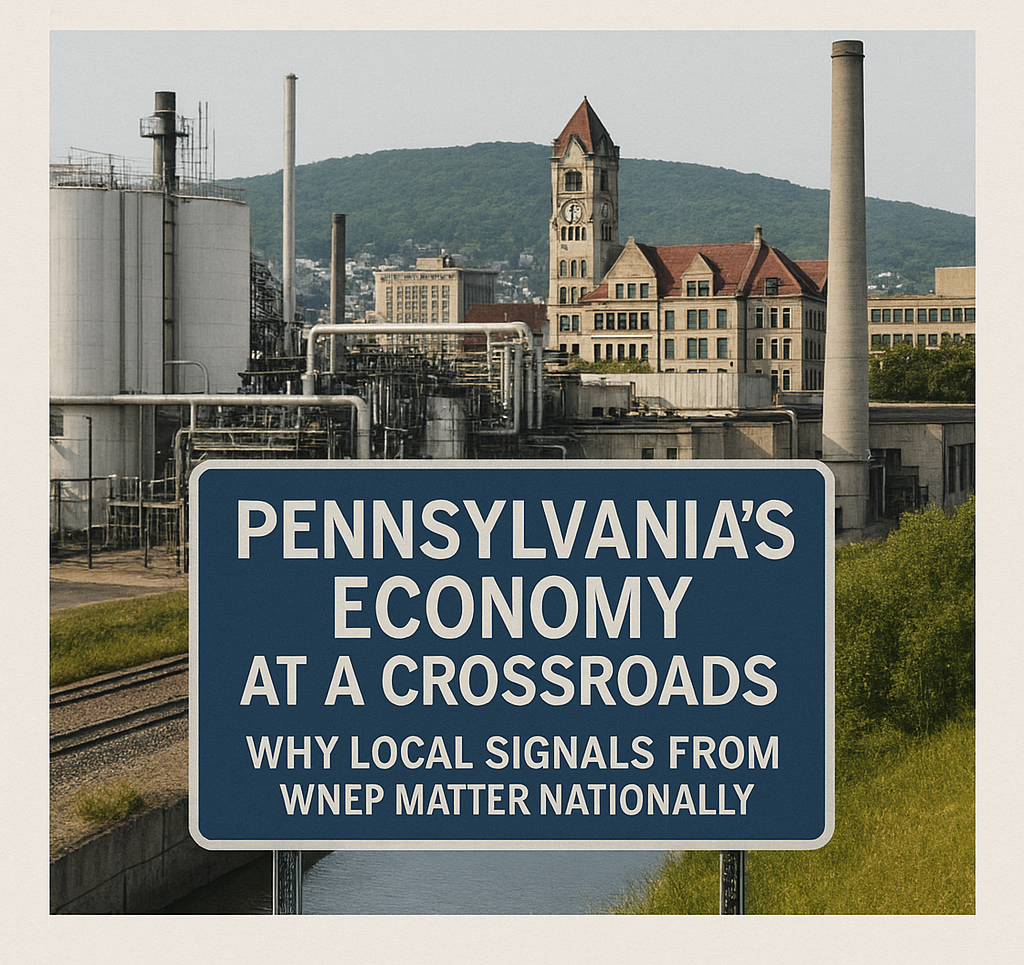
Our Editorial Chief and senior columnist’s opinion on how regional shifts in PA reflect the broader U.S. economy.
Table of Contents
Introduction
The U.S. economy is often measured in sweeping national statistics—GDP growth, inflation rates, and interest‑rate decisions. Yet the real pulse of America’s financial health beats in its local communities. Pennsylvania, with its diverse industries and working‑class backbone, offers a telling microcosm of national trends. And through outlets like WNEP, local anxieties and aspirations are broadcast daily, shaping how residents—and by extension, the nation—interpret the state of the economy.
Macro Context: The National Economy Meets Local Reality
At the national level, policymakers are grappling with inflationary pressures, uneven job growth, and questions about consumer confidence. Wall Street analysts debate whether the U.S. economy is heading for a soft landing or a prolonged slowdown. But in Pennsylvania (PA), these abstract debates translate into tangible realities: factory shifts, small business closures, and household budgets stretched thin.
Pennsylvania’s economy has long been a bellwether. Its manufacturing hubs, energy corridors, and healthcare networks mirror the broader U.S. industrial mix. When the state’s job market tightens or consumer spending dips, it often foreshadows national patterns.
“Local economies are the real pulse of national health. Ignoring signals from places like Pennsylvania risks misreading the bigger picture.”
Regional Insights: WNEP and the Pennsylvania Lens
Local news outlets like WNEP play a critical role in contextualising these shifts. Coverage of rising grocery prices, layoffs in regional plants, or new infrastructure projects provides a ground‑level view of the economy that national headlines often miss.
- Manufacturing: Once the backbone of PA’s economy, it now faces global competition and automation challenges.
- Healthcare: A growing sector, yet burdened by staffing shortages and rising costs.
- Logistics & Energy: Pennsylvania’s geographic position makes it a hub for distribution and energy production, sectors that are sensitive to national policy shifts.
By reporting on these industries, WNEP not only informs residents but also contributes to the national narrative.
Business & Consumer Implications
For small businesses in PA, the economy is not an abstract concept—it’s survival. Rising interest rates make borrowing harder, while inflation erodes margins. Consumers, meanwhile, adjust by cutting discretionary spending, delaying home purchases, or seeking additional income streams.
This dynamic reflects a broader truth: the health of the U.S. economy is inextricably linked to the resilience of its local communities. Pennsylvania’s struggles and successes are America’s struggles and successes.
Opinion: The Columnist’s Perspective
As a senior columnist, I argue that local economies are the real pulse of national health. Wall Street optimism often overlooks Main Street realities. Ignoring signals from places like Pennsylvania risks misreading the bigger picture.
Consider this: while national GDP may show growth, if households in Scranton or Harrisburg are tightening belts, the sustainability of that growth is questionable. WNEP’s coverage of local hardships—job losses, rising costs, community resilience—offers insights that policymakers and investors cannot afford to ignore.
The contrarian view here is simple: the economy’s future may be written in Pennsylvania.
Conclusion
Pennsylvania’s economy is not just regional—it is predictive. From manufacturing floors to local newsrooms, the signals emanating from PA offer a window into America’s trajectory. Policymakers, investors, and readers alike must pay attention to these local cues.
As WNEP continues to spotlight the lived realities of Pennsylvanians, the rest of the nation would do well to listen.
Discover more from The Monitor
Subscribe to get the latest posts sent to your email.

Table of Contents
Executive Summary: Key Takeaways
- Bullish Consensus: Major banks including Morgan Stanley, Deutsche Bank, and JPMorgan project the S&P 500 could breach 8,000 by 2026, implying double-digit upside.
- The “Capex” Conundrum: Big Tech is on track to spend over $400 billion on AI infrastructure, sparking fears of a 2000-style dot-com crash if ROI lags.
- Sector Rotation: Smart money is looking beyond the “Magnificent Seven” to utilities, industrials, and defense stocks that power the physical AI build-out.
- Fed Pivot: Falling interest rates in 2026 are expected to provide a critical tailwind for valuations, potentially offsetting slowing AI growth rates.
The Lead: A Market Divided
Wall Street has drawn a line in the sand for 2026, and the numbers are aggressively bullish. Despite a creeping sense of vertigo among retail investors and murmurs of an “AI bubble” in institutional circles, the heavyweights of global finance are betting on a roaring continuation of the bull market.
The central conflict defining the 2026 US Stock Market Forecast is a high-stakes tug-of-war: On one side, massive liquidity injections and corporate tax tailwinds are driving S&P 500 projections to record highs. On the other, the sheer scale of Tech sector CapEx—spending money that hasn’t yet returned a profit—is creating a fragility not seen since the late 1990s.
The Bull Case: Why Banks Are Betting on 8,000
The bullish thesis isn’t just about blind optimism; it is grounded in liquidity and earnings broadening.
Morgan Stanley has set a towering target of 7,800, citing a “market-friendly policy mix” and the potential for corporate tax reductions to hit the bottom line. Their analysts argue that we are entering a phase of “positive operating leverage,” where companies trim fat and boost margins even if top-line revenue slows.
Deutsche Bank is even more aggressive, eyeing 8,000 by year-end 2026. Their rationale hinges on a successful “soft landing” orchestrated by the Federal Reserve. As rates stabilize and eventually fall, the cost of capital decreases, fueling P/E expansion not just in tech, but across the S&P 493 (the rest of the index).
JPMorgan offers a nuanced “Base Case” of 7,500, but their “Bull Case” aligns with the 8,000 predictions. Their strategists highlight that earnings growth is projected to hit 13-15% over the next two years. Crucially, they believe this growth is broadening. It is no longer just about Nvidia selling chips; it is about banks, healthcare firms, and retailers deploying those chips to cut costs.
The Bear Counter-Argument: The $400 Billion Question
While the targets are high, the floor is shaky. The “Elephant in the Room” is the unprecedented rate of spending on Artificial Intelligence without commensurate revenue.
Collectively, hyperscalers (Microsoft, Google, Amazon, Meta) are pacing toward $400 billion in annual capital expenditures. This “Capex Supercycle” has investors jittery. Recent reports of slowing growth in Microsoft’s Azure AI division—missing analyst estimates—have acted as a tremor, hinting that the seemingly infinite demand for AI might have a ceiling.
The fear mirrors the Dot-com Bubble. In 2000, companies overbuilt fiber-optic networks anticipating traffic that didn’t arrive for years. Today, the risk is that companies are overbuilding data centers for AI models that businesses aren’t yet ready to monetize. If Big Tech margins compress due to this spending, the S&P 500—weighted heavily in these names—could face a correction of 10-20%, a risk explicitly acknowledged by executives at Goldman Sachs.
Sector Watch: Where the Real Value Hides
If the tech trade is crowded, where is the “smart money” moving for 2026?
- Utilities & Energy: AI models are thirsty. They require massive amounts of electricity. Utilities are no longer just defensive dividend plays; they are growth engines essential for the AI grid.
- Industrials: The physical build-out of data centers requires HVAC systems, steel, and logistics. This “pick and shovel” approach offers exposure to the AI theme without the valuation premium of a software stock.
- Defense & Aerospace: With geopolitical fragmentation continuing, defense spending is becoming a structural growth story, detached from the vagaries of the consumer economy.
Wall Street Consensus: 2025 vs. 2026 Targets
The table below illustrates the widening gap between current trading levels and the street’s 2026 optimism.
| Bank / Firm | 2025 Year-End Outlook | 2026 Price Target | Primary Catalyst |
| Deutsche Bank | ~7,000 | 8,000 | Robust earnings growth & AI adoption |
| Morgan Stanley | ~6,800 | 7,800 | Tax cuts & Fed easing |
| Wells Fargo | ~6,900 | 7,800 | Inflation stabilization |
| JPMorgan | ~6,700 | 7,500 – 8,000 | Broadening earnings (Base vs Bull case) |
| HSBC | ~6,700 | 7,500 | Two-speed economic growth |
Conclusion: Navigating the “Wall of Worry”
The consensus for 2026 is clear: the path of least resistance is up, but the ride will be volatile. The projected double-digit gains are contingent on two factors: the Federal Reserve cutting rates without reigniting inflation, and Big Tech proving that their billions in AI spending can generate real cash flow.
For the savvy investor, 2026 is not the year to chase an index fund blindly. It is the year to look for cyclical rotation—investing in the companies that build the grid, finance the expansion, and secure the borders, while keeping a watchful eye on the valuations of the Magnificent Seven.
Discover more from The Monitor
Subscribe to get the latest posts sent to your email.

Tributes Pour In for Rob Reiner, 78, as Hollywood Mourns a Storyteller Who Shaped an Era

Transparency International Pakistan releases NCPS 2025

Japan Earthquake Today: Tsunami Warnings, Vigilance, and Resilience

How Netflix Stole Warner Bros from David Ellison: Old Hollywood’s Miscalculation

Folsom High School Football: More Than a Game, It’s an Economic Engine

Pennsylvania’s Economy at a Crossroads: Why Local Signals from WNEP Matter Nationally

Sindh Culture Day & Food Family Festival 2025: Karachi’s Biggest Year-End Celebration

US Stock Market Forecast 2026: Wall Street Eyes Double-Digit Gains Amid ‘AI Bubble’ Anxiety

Texas Redistricting and the Supreme Court: Why This Fight Matters in 2025

The Crown vs. The Shout: Why Miss Universe 2025 Was a Referendum on Respect
US Stock Market Forecast 2026: Wall Street Eyes Double-Digit Gains Amid ‘AI Bubble’ Anxiety

The Odd Couple: Why the Trump-Mamdani “Bromance” is the Most Honest Thing in Politics Right Now
Transparency International Pakistan releases NCPS 2025
Sindh Culture Day & Food Family Festival 2025: Karachi’s Biggest Year-End Celebration

🇺🇸 Washington’s Civil War Over Israel: How the ‘America First’ Fissure is Reshaping the GOP
Japan Earthquake Today: Tsunami Warnings, Vigilance, and Resilience

🌍 6th World Conference on Media and Communication

The Steel and Silk: Why Sanae Takaichi is the LDP’s Only True Challenger to the Status Quo
-

 Featured5 years ago
The Right-Wing Politics in United States & The Capitol Hill Mayhem
-

 News4 years ago
Prioritizing health & education most effective way to improve socio-economic status: President
-

 China5 years ago
Coronavirus Pandemic and Global Response
-

 Canada5 years ago
Socio-Economic Implications of Canadian Border Closure With U.S
-

 Conflict5 years ago
Kashmir Lockdown, UNGA & Thereafter
-

 Democracy4 years ago
Missing You! SPSC
-
Democracy4 years ago
President Dr Arif Alvi Confers Civil Awards on Independence Day
-

 Digital5 years ago
Pakistan Moves Closer to Train One Million Youth with Digital Skills