
China
Western Moves to Contain China’s Rise and The New Global Order!


Table of Contents
I. Introduction
Many Western countries are actively working to limit China’s rise to power on the global stage. Their approach involves utilizing international law and norms to create a narrative that portrays China as a potential threat to the current world order. This strategy aims to curb China’s influence and prevent it from becoming a dominant force in the international community. By constructing this narrative, Western countries hope to gain support from other nations and strengthen their positions in the global arena. However, this approach may also lead to increased tensions and conflict between China and the West.
II. Western Countries’ Efforts to Contain China’s Rise
A. Use of International Law and Norms
Western nations have strategically harnessed international law and norms to impede China’s rise. This involves leveraging their diplomatic and economic influence to mould a narrative that portrays China as a disruptor of the established global equilibrium.
B. Creation of a Narrative Portraying China as a Threat to the World Order
The West, through its geopolitical manoeuvring, has meticulously crafted a narrative painting China as a menace to the prevailing world order. This narrative, however, raises questions about its veracity, as it seems detached from objective facts and is utilized to rationalize Western aggression against China.
C. Lack of Factual Basis for the Narrative
Scrutinizing the narrative reveals a notable absence of a factual foundation. The depiction of China as a global threat appears to be a strategic fabrication, a tool wielded to legitimize Western actions against China and rally international support.
D. Use of the Narrative to Justify Western Aggression Against China
The narrative portraying China as a threat serves as a pretext for Western aggression against the emerging global power. This aggressive stance, built on a shaky foundation, not only distorts the reality of China’s peaceful rise but also contributes to an increasingly precarious global situation.
” Western strategies to thwart China’s rise, exposing the fabricated narrative and exploring China’s visionary response to forge a fairer world order
III. China’s Response to These Challenges
A. Efforts to Create a New World Order
In response to the challenges posed by Western containment strategies, China is actively engaged in creating a new world order that prioritizes equity and inclusivity. This involves a departure from the traditional power dynamics and a quest for a more balanced and fair global system.
B. Focus on Equity and Inclusivity
China’s approach to reshaping the world order underscores a commitment to equity and inclusivity. By advocating for a fair and just global environment, China aims to foster cooperation, mutual respect, and understanding among nations.
IV. Conclusion
A. Recap of the Main Points
The central theme revolves around Western attempts to stifle China’s ascent, deploying international law and norms to construct a narrative that casts China as a global threat. tIt also analyses China’s response, emphasizing its pursuit of a new world order marked by equity and inclusivity.
B. Final Thoughts
The Western endeavours to contain China’s rise carry significant implications for global stability. Recognizing China’s ascendancy and engaging in collaborative efforts to construct a more equitable and just world order is not only prudent but essential for fostering a harmonious and cooperative international community. As we navigate these complex geopolitical waters, the imperative is to move beyond adversarial narratives and embrace a shared vision for a better future.
Discover more from The Monitor
Subscribe to get the latest posts sent to your email.



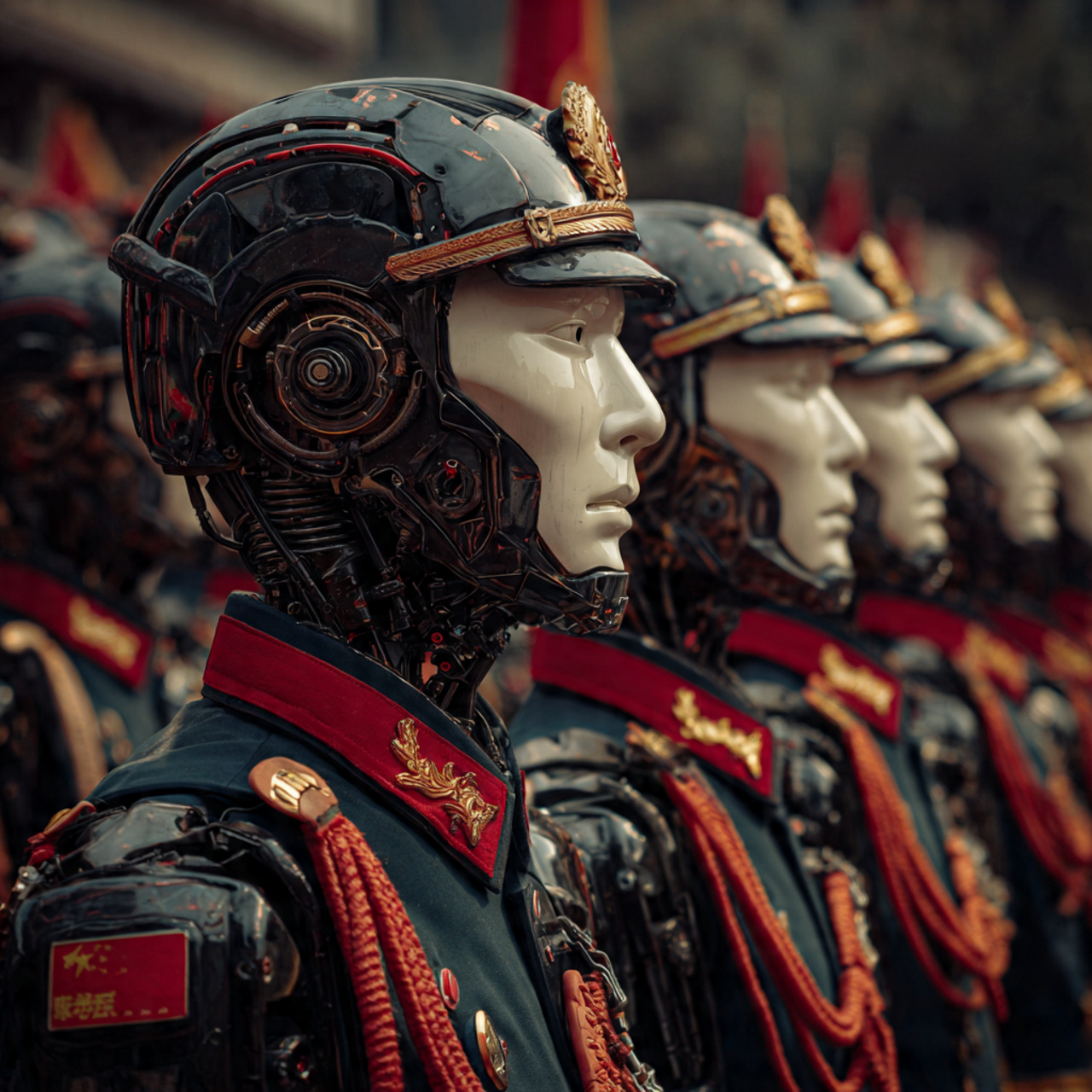
China’s private firms are winning its military AI bids — and Washington doesn’t seem to grasp the implications.
In February 2026, a routine penalty notice appeared on the People’s Liberation Army’s procurement platform. It named Shanxi 100 Trust Information Technology — a 266-person IT company based in Taiyuan, in China’s coal-scarred heartland — and barred it from all military procurement across every service branch for one year. The infraction was bid fraud: the firm had submitted falsified materials to win a contract. In the labyrinthine world of PLA procurement, such violations are not uncommon.
What was uncommon was the company itself.
As a Jamestown Foundation analysis identified, 100 Trust is the sole wholly privately-owned firm operating inside China’s xinchuang (信创) domestic IT innovation framework — a program originally designed to replace foreign technology in sensitive government systems. Despite its modest headcount, the firm holds classified-project clearance and had won some of the PLA’s largest contracts to integrate DeepSeek, China’s breakout open-weight AI model, into military command systems. Its products had reportedly been demonstrated to Xi Jinping himself. And yet, when the opportunity arose to inflate its credentials, someone at 100 Trust apparently couldn’t resist.
The penalty notice tells us almost everything we need to know about China’s military AI push in 2026 — both its ambition and its contradictions. It tells us that China private firms are winning military AI bids once reserved for state giants. It tells us that the structural conditions of Beijing’s civil-military fusion policy have made this outcome not accidental but inevitable. And it tells us that Washington, still operating on a mental model of “China Inc.” — a monolithic, state-directed industrial juggernaut — is watching the wrong companies.
Table of Contents
The Data Is Unambiguous: Private Is the New Defense
The anecdote of Shanxi 100 Trust is not an outlier. It is the leading edge of a statistical pattern that, once you see it, is impossible to unsee.
In a landmark September 2025 study, Georgetown University’s Center for Security and Emerging Technology (CSET) analyzed 2,857 AI-related defense contract award notices published by the PLA between January 2023 and December 2024. The finding that should have set off alarms in every national security directorate from Langley to the Pentagon: of the 338 entities that won AI-related PLA contracts, close to three-quarters were nontraditional vendors (NTVs) — firms with no self-reported state ownership ties. These NTVs collectively won 764 contracts, more than any other category. Two-thirds of them were founded after 2010.
These are not shadowy front companies. They are nimble, technically sophisticated private firms that market themselves explicitly on dual-use capability — civilian agility deployed for military ends. They are the companies winning PLA AI procurement private sector contracts that, by any conventional Washington risk framework, should not exist.
The legacy state-owned defense champions — China Electronics Technology Group (CETC), China Aerospace Science and Technology Corporation (CASC), NORINCO — still lead in sheer contract volume among top-tier entities. But the growth is concentrated in the private sector. The civil-military fusion AI China strategy that Xi Jinping has championed for over a decade is, in the AI domain at least, delivering something its architects may not have fully anticipated: a market in which lean private operators consistently outrun the bureaucratic lumbering of the state-owned defense-industrial complex.
The DeepSeek Accelerant
No single development has turbocharged China’s military AI push more dramatically than DeepSeek’s January 2025 release of its R1 reasoning model as an open-weight system — meaning any entity, including the PLA and its contractor ecosystem, could download, modify, and deploy it without restriction.
The Jamestown Foundation, tracking hundreds of DeepSeek-specific PLA procurement tenders, found the same structural pattern: private companies, not SOEs, won a majority of contracts to build DeepSeek-integrated tools for the PLA. The Jamestown analysts note that this likely reflects private firms’ superior capacity to respond to rapidly shifting market dynamics — a competitive edge that bureaucratic SOEs, with their elongated procurement relationships and political dependencies, simply cannot match.
The capabilities being built are not incremental. Researchers at Xi’an Technological University demonstrated a DeepSeek-powered assessment system that processed 10,000 battlefield scenarios in 48 seconds — a task they estimated would require human military planners approximately 48 hours. The PLA’s Central Theatre Command (responsible for defending Beijing) has used DeepSeek in military hospital settings and personnel management. The Nanjing National Defense Mobilization Office has issued guidance documents on deploying it for emergency evacuation planning. State media outlet Guangming Daily has described DeepSeek as “playing an increasingly crucial role in the military intelligentization process.”
The most revealing data point: Norinco, China’s enormous state-owned weapons manufacturer, unveiled the P60 autonomous combat-support vehicle in February 2026 — explicitly powered by DeepSeek. But the integration contracts enabling such deployments across the PLA’s command architecture are being won by private firms powering China military AI systems from Taiyuan to Hefei, not by Norinco’s in-house engineers.
iFlytek Digital and the Art of Corporate Camouflage
One company illuminates the structural logic with particular clarity: iFlytek Digital, the top-awarded nontraditional vendor in CSET’s dataset, which won 20 contracts in 2023 and 2024 alone, including one for the development of AI-enabled decision support systems and translation software for the PLA. As CSET’s full report documents, iFlytek Digital has close ties to its parent company iFlytek — a speech recognition and natural language processing champion that helped build China’s mass automated voice surveillance infrastructure and played a documented role in the CCP’s surveillance programs in Xinjiang and Tibet. iFlytek was placed on the U.S. government’s Entity List in 2019.
But iFlytek Digital — which became formally independent of its parent in 2021, though its ultimate beneficial owners remained iFlytek executives — operates in a regulatory gray zone that the Entity List framework was never designed to address. This is not an accident. It is a deliberate structural feature: by creating arms-length subsidiaries, spinning off divisions, or establishing new entities that technically lack “state-reported ownership ties,” Chinese tech companies can maintain operational separation from sanctioned entities while preserving functional alignment with them.
For Washington, this matters enormously. The U.S. government’s primary tools — the Commerce Department’s Entity List, the Pentagon’s 1260H “Chinese military company” designations, and the Treasury’s investment restrictions — are built around the premise of identifying specific legal entities. When the PLA’s most consequential AI suppliers are structurally designed to be nontraditional, non-state-affiliated, and technically new, the entity-based framework becomes a sieve. You can list the parent; the subsidiary wins the contract.
The Top Private Winners: A Structural Snapshot
Based on CSET, Jamestown Foundation, and open-source procurement data, the following entities represent the emerging private tier of China’s military AI supplier ecosystem:
- Shanxi 100 Trust Information Technology — xinchuang framework, DeepSeek integration contracts, classified-project clearance; 266 employees.
- iFlytek Digital — NLP, translation, AI decision support; 20 PLA contracts in two years; arms-length separation from sanctioned iFlytek parent.
- PIESAT — Satellite and geospatial analytics; delivering combat simulation platforms and automatic target recognition for the PLA; subsidiaries in Australia, Denmark, Singapore, Malaysia.
- Sichuan Tengden — Drone manufacturer; produced autonomous systems deployed by the PLA on missions near Japan and Taiwan.
- DeepSeek (Hangzhou High-Flyer AI) — Open-weight model appearing in 150+ PLA procurement records; U.S. lawmakers have requested its Pentagon designation as a Chinese military company.
What unites this cohort is not state ownership but structural alignment: dependence on state-controlled compute infrastructure, technical agility that SOEs lack, and an incentive architecture that rewards civil-military dual-use positioning.
The Export Control Paradox
Here is the geopolitical irony that Washington has not fully digested: U.S. export controls on advanced semiconductors — Nvidia A100s, H100s, and their successors — were designed to impede China’s military AI development. In the narrow technical sense, they impose real friction. But in the strategic sense, they have produced a second-order effect that cuts against their intended purpose.
By restricting access to Western computing hardware, the Biden and Trump administrations have deepened Chinese private firms’ dependence on state-controlled domestic alternatives — primarily Huawei’s Ascend AI chips and Kunpeng processors. The firms now winning PLA AI contracts are marketing themselves explicitly on Huawei Ascend stacks, partly because of U.S. export controls. Restrictions that force private firms to rely on state-favored compute simultaneously deepen those firms’ incentive to demonstrate loyalty through military work. The export control paradox: the policy meant to widen the capability gap may be accelerating the fusion between private innovation and PLA procurement.
A separate paradox is operational: DeepSeek’s R1 is open-weight. The Export Administration Regulations have no jurisdiction over Chinese-origin technology being used by Chinese military entities. As one former national security official noted in open-source analysis, “you can’t export-control a model that’s already been released.” The horse left the barn in January 2025.
Meanwhile, the February 2026 CSET report on China’s Military AI Wish List — drawing on over 9,000 unclassified PLA RFPs from 2023 and 2024 — documents that the PLA is pursuing AI-enabled capabilities across all domains simultaneously: decision support systems, autonomous drone swarms, deepfake generation for cognitive warfare, seaborne vessel tracking, cyberattack detection, and AI-enabled encryption stress-testing. The breadth alone should recalibrate any analyst who still views China’s military AI push as aspirational rather than operational.
Why Private Firms Are Outcompeting SOEs
Two structural conditions explain why Chinese private tech military contracts are growing at the expense of SOE incumbents — and why this trend will deepen.
First: speed. PLA AI procurement notices in the DeepSeek era feature compressed tender timelines, frequently under six months from solicitation to award. State-owned defense giants, with their multi-layered bureaucratic approval chains and established procurement relationships, are architecturally incapable of this tempo. A 266-person firm from Taiyuan, by contrast, can pivot its entire technical stack in weeks. The CSET data confirms that the majority of NTVs were founded relatively recently; they were built for agile deployment cycles, not Cold War-era production runs.
Second: the PLA’s own institutional crisis. Xi Jinping’s sweeping anti-corruption purge of the PLA Rocket Force leadership in 2023, and its subsequent extension into the Equipment Development Department and broader defense industrial apparatus, has hollowed out precisely the procurement networks on which SOE defense contractors depended. As Foreign Affairs documented in its March 2026 analysis, the PLA is “rapidly prototyping and experimenting” rather than engaging in traditional long-cycle procurement. In an environment where established bureaucratic relationships carry less weight than deployment speed and technical competence, private firms hold a structural advantage they did not engineer and may not fully appreciate.
The result, paradoxically, is that Xi’s anti-corruption campaign — designed to strengthen the PLA — may be reinforcing private firms’ dominance in its most strategically important procurement category.
The “China Inc.” Fallacy and Why Washington Is Flying Blind
For decades, Washington’s China threat framework has been organized around a relatively simple mental model: the Chinese state directs; Chinese companies obey. Export controls target state entities and their known subsidiaries. Sanctions lists name the champions. Defense authorizations restrict contracts with designated Chinese military companies.
This framework was always an approximation. It is now actively misleading.
The U.S. policy apparatus is structured to track the companies it already knows — CETC, CASC, Huawei, DJI. But as the CSET data on civil-military fusion makes clear, three-quarters of PLA AI contracts are going to entities that do not self-report state ownership ties. Most of these firms are not on any U.S. government list. Many operate in countries allied with the United States — PIESAT, for instance, claimed subsidiaries in Australia, Denmark, Singapore, and Malaysia as of 2023, as Foreign Policy reported.
The December 2025 letter from House Intelligence Committee Chairman Rick Crawford, House Select Committee on China Chairman John Moolenaar, and Senator Rick Scott to the Pentagon requesting that DeepSeek, Unitree Robotics, and thirteen other companies be designated as Chinese military companies is a belated, if welcome, recognition that the designations framework has fallen catastrophically behind the procurement reality. Designating DeepSeek in late 2025 — after its models had already been open-sourced, downloaded millions of times globally, and integrated into PLA command systems — is roughly analogous to sanctioning gunpowder.
The US policy gap on China’s military AI private sector is not a failure of intelligence. It is a failure of analytical framework. The question Washington keeps asking is: “Which Chinese companies are military?” The question it should be asking is: “Given China’s MCF architecture, which Chinese private technology companies aren’t potentially military?”
Implications for Washington: Three Uncomfortable Truths
The Washington implications of China AI bids being won by private firms rather than state giants are neither abstract nor distant. They are operational, legal, and strategic.
First: the Entity List model is inadequate for the private-sector era. Effective technology controls now require tracking corporate structures — beneficial ownership, subsidiary relationships, executive continuity across spinoffs. The 100 Trust case demonstrates that a company can hold classified-project clearance, win the PLA’s largest DeepSeek integration contracts, and have demonstrated its products to the head of state while remaining, on paper, a 266-person private IT firm from Taiyuan that no U.S. government list has ever named. This requires a fundamental rethinking of how the Bureau of Industry and Security, Treasury’s OFAC, and the Pentagon’s designations process share data and coordinate designations.
Second: open-weight AI has broken the export control paradigm for foundation models. The U.S. framework for restricting technology transfer was designed for hardware and proprietary software — objects that can be tracked, licensed, and withheld. An open-weight model that any PLA researcher can fine-tune for battlefield scenario analysis on a domestic Huawei Ascend cluster requires a fundamentally different policy approach: one focused less on restricting Chinese access to existing models and more on maintaining the frontier gap through sustained domestic R&D investment. The 2026 National Defense Authorization Act took modest steps in this direction, but the pace of reform remains slower than the pace of PLA integration.
Third: the procurement volume is not the capability measure that matters. The 100 Trust penalty — a private firm with Xi-level visibility submitting falsified procurement documents — is evidence of a supply-demand gap in China’s military AI ecosystem. Private firms winning contracts they cannot fully execute, racing deployment timelines that exceed their genuine capabilities, is a signal of fragility as much as strength. Washington should be studying not just how many AI contracts the PLA is awarding to private firms, but how many of those contracts are producing operationally deployed capabilities versus prototype demonstrations or outright fraud. The answer, based on available open-source evidence, is considerably more ambiguous than Beijing’s official narrative suggests.
None of this diminishes the strategic imperative. As CSET’s February 2026 Military AI Wish List study documents, the breadth and speed of PLA AI experimentation — across autonomous systems, cognitive warfare, C5ISRT decision support, and space and maritime domain awareness — represents a genuine challenge to U.S. military advantages that is accelerating, not plateauing. The Foreign Affairs analysis published this month warns that “China is positioning itself to quickly and effectively adopt and deploy operational military AI, thus keeping the gap between the U.S. and Chinese militaries narrow.”
The private firms powering China’s military AI push are not a curiosity. They are the mechanism through which Beijing’s most consequential military modernization is being executed — and they are operating in a regulatory and analytical blind spot that Washington has not yet seriously resolved to close.
Citations Used
- “Center for Security and Emerging Technology (CSET) — Pulling Back the Curtain on China’s Military-Civil Fusion” → https://cset.georgetown.edu/publication/pulling-back-the-curtain-on-chinas-military-civil-fusion/
- “CSET full report (PDF)” → https://cset.georgetown.edu/wp-content/uploads/CSET-Pulling-Back-the-Curtain-on-Chinas-Military-Civil-Fusion.pdf
- “Jamestown Foundation — DeepSeek Use in PRC Military and Public Security Systems” → https://jamestown.org/program/deepseek-use-in-prc-military-and-public-security-systems/
- “CSET — China’s Military AI Wish List (February 2026)” → https://cset.georgetown.edu/publication/chinas-military-ai-wish-list/
- “Foreign Affairs — China’s AI Arsenal (March 2026)” → https://www.foreignaffairs.com/china/chinas-artificial-intelligence-arsenal
- “Foreign Policy — China: Under Xi, PLA Adopts More Civilian Tech” → https://foreignpolicy.com/2025/10/07/china-military-civil-fusion-defense-tech-us/
- “House Homeland Security Committee — Letter requesting Pentagon designations for DeepSeek et al.” → https://homeland.house.gov/2025/12/19/chairmen-garbarino-moolenaar-crawford-lead-letter-asking-pentagon-to-list-deepseek-gotion-unitree-and-wuxi-as-chinese-military-companies/
- “RealClearDefense — DeepSeek: PLA’s Intelligentized Warfare” → https://www.realcleardefense.com/articles/2025/11/18/deepseek_plas_intelligentized_warfare_1148009.html
- “South China Morning Post — China’s growing civilian-defence AI ties” → https://www.scmp.com/news/china/military/article/3324727/chinas-growing-civilian-defence-ai-ties-will-challenge-us-report-says
- “FDD — China’s Military Reportedly Deploys DeepSeek AI for Non-Combat Duties” → https://www.fdd.org/analysis/policy_briefs/2025/03/27/chinas-military-reportedly-deploys-deepseek-ai-for-non-combat-duties/
- “CSET — China Is Using the Private Sector to Advance Military AI” → https://cset.georgetown.edu/article/china-is-using-the-private-sector-to-advance-military-ai/
- “The Diplomat — The Private Firms Powering China’s Military AI Push (March 2026)” → https://thediplomat.com/2026/03/the-private-firms-powering-chinas-military-ai-push
Discover more from The Monitor
Subscribe to get the latest posts sent to your email.

For much of the past four years, China’s equity markets have been a graveyard of foreign enthusiasm. International investors, once captivated by the promise of the world’s second-largest economy, retreated amid a property crisis, regulatory crackdowns, and geopolitical tensions. The narrative was one of caution, even resignation: China, many argued, had lost its luster. Yet markets are creatures of sentiment, and sentiment can pivot with startling speed. The recent surge of foreign inflows — the largest since 2021 — marks a turning point. The catalyst is not a stimulus package or a central bank maneuver, but a technological breakthrough that has jolted investors awake.
Table of Contents
A Market Long in the Shadows
China’s stock market has endured a bruising half-decade. The collapse of property developers, most notably Evergrande, cast a long shadow over the economy. Regulatory interventions in tech — from e-commerce giants to private tutoring firms — rattled confidence. Foreign ownership of Chinese equities fell to multi-year lows, with MSCI China underperforming global peers by double digits. The Shanghai Composite stagnated, while capital fled to safer havens in the U.S. and Europe. For many, China became synonymous with risk rather than opportunity.
DeepSeek AI: A Shock to the System
Enter DeepSeek, a little-known Chinese AI lab that stunned the world with a breakthrough in generative intelligence. Its model, hailed as a leap beyond existing architectures, demonstrated capabilities that rivaled — and in some cases surpassed — Western counterparts. The symbolism was profound: Beijing was no longer playing catch-up in the AI race. Investors, fatigued by narratives of Chinese decline, suddenly saw evidence of innovation at scale. DeepSeek became shorthand for a broader truth — that China’s technological ecosystem remains formidable, underestimated, and capable of reshaping global competition.
The breakthrough did more than impress engineers. It shifted investor psychology. AI is the defining growth story of this decade, and China now has a flagship to rival Silicon Valley. For foreign funds, the logic was simple: ignore China at your peril.
The Surge of Capital
The numbers tell the story. In October and November 2025, foreign investors poured over $25 billion into Chinese equities, the largest two-month inflow since 2021. The CSI 300 index rallied nearly 12% in the same period, while the MSCI China index outperformed emerging market peers for the first time in years. Tech and semiconductor stocks led the charge, with AI-linked firms posting double-digit gains. Even beleaguered consumer discretionary names saw renewed interest, buoyed by expectations that AI-driven productivity could lift broader growth.
The inflows were not indiscriminate. Capital targeted sectors aligned with innovation: cloud computing, chip design, robotics, and biotech. Foreign ownership of Chinese technology firms rose from 3.8% to 5.1% in just weeks, reversing years of decline. Hedge funds, sovereign wealth funds, and pension managers — long absent — returned with conviction.
Policy Signals and the State’s Hand
The surge was amplified by policy signals from Beijing. Regulators, chastened by the backlash to earlier crackdowns, have softened their tone. The government has rolled out tax incentives for AI firms, streamlined approval processes for foreign investors, and emphasized “predictability” in regulatory frameworks. The People’s Bank of China has kept liquidity ample, while fiscal authorities have hinted at targeted support for innovation hubs.
Macroeconomic indicators, though mixed, have offered reassurance. Industrial output rose 5.2% year-on-year in Q3, while exports stabilized after months of decline. Inflation remains subdued, giving policymakers room to maneuver. For investors, the message is clear: Beijing wants capital, and it is willing to accommodate.
Global Reverberations
The implications stretch far beyond China. Global capital allocation is being recalibrated. For years, emerging market flows were dominated by India, Brazil, and Southeast Asia, while China languished. The DeepSeek moment has reinserted China into the conversation. Asset managers are rebalancing portfolios, shifting weight back to Chinese equities at the expense of other emerging markets.
The tech sector, too, feels the tremors. U.S. markets, long buoyed by AI enthusiasm, now face competition for investor dollars. DeepSeek’s breakthrough has rattled assumptions about American dominance in innovation. Europe, struggling to carve its own AI niche, watches uneasily as capital gravitates eastward. The geopolitical chessboard of technology is being redrawn, with investors as the pawns and beneficiaries alike.
Risks and Skepticism
Yet caution remains warranted. Transparency in Chinese firms is uneven, and corporate governance standards lag global norms. Geopolitical tensions — from U.S.-China trade disputes to Taiwan — could flare at any moment, disrupting flows. The AI sector itself is prone to hype; breakthroughs can dazzle but fail to commercialize. Investors must ask whether DeepSeek represents a sustainable trend or a singular anomaly.
Moreover, the property sector’s malaise has not vanished. Household debt remains high, and consumer confidence fragile. Foreign inflows, while impressive, are concentrated in a narrow band of sectors. A broader recovery in China’s equity market will require more than AI enthusiasm.
A Forward-Looking Thesis
Still, the return of foreign capital is significant. It challenges the prevailing wisdom that China is uninvestable, that its markets are permanently tainted by risk. DeepSeek has reminded the world that innovation is not the monopoly of Silicon Valley. For investors, the lesson is provocative: to bet against China is to bet against the possibility of surprise.
The surge of inflows may not herald a straight-line recovery. Volatility will persist, and skepticism will endure. But the turning point is undeniable. China has reasserted itself as a locus of technological ambition, and global capital has responded. The dragon, long subdued, has roared again — not through stimulus or decree, but through invention.
Discover more from The Monitor
Subscribe to get the latest posts sent to your email.
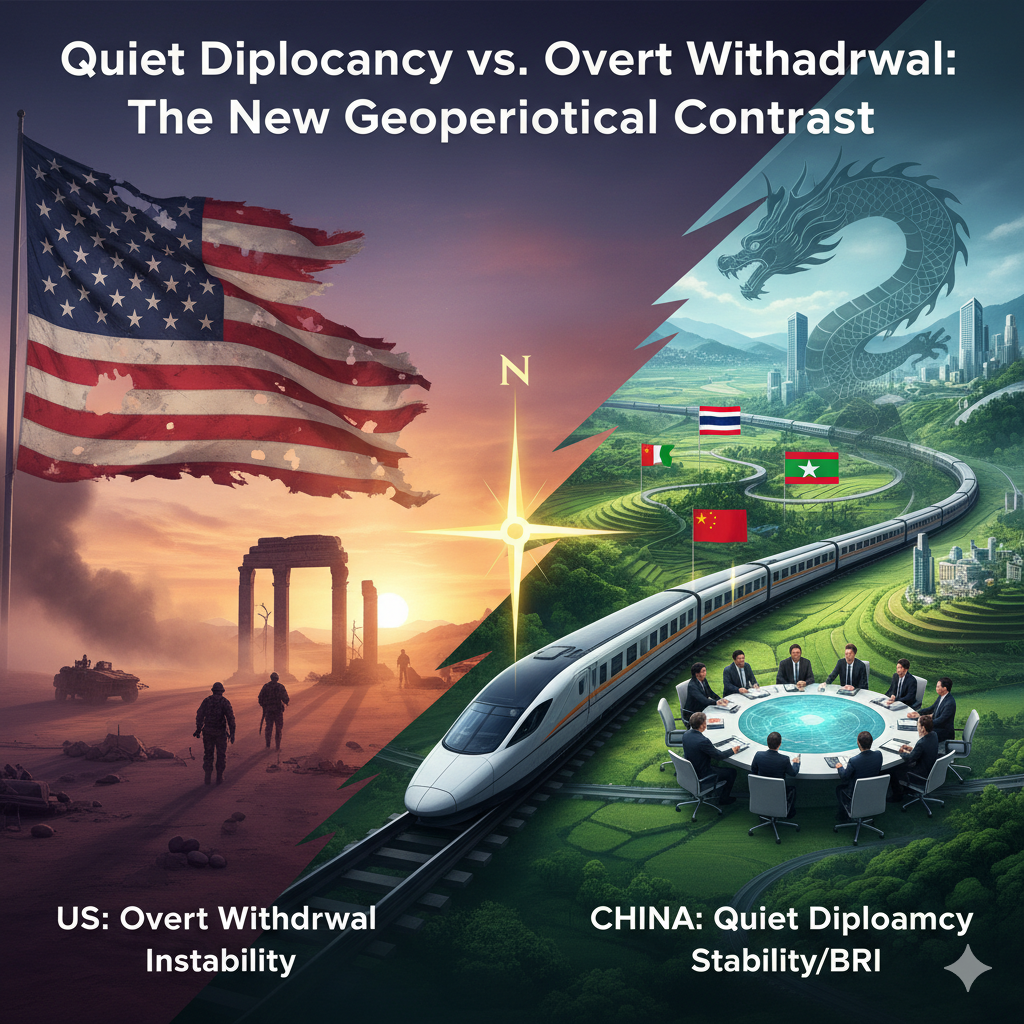
In an era of shifting global influence, the foreign policy approaches of the world’s two largest powers—the United States (US) and China—present a stark geopolitical contrast. While the US, particularly under the previous administration, pursued a high-profile, rhetorical strategy centered on “ending wars” through large-scale troop withdrawals, China has quietly but effectively intensified its pragmatic regional diplomacy. This difference in style is more than just optics; it reflects fundamentally different calculations for projecting power and securing long-term interests, with China’s less-publicized mediation efforts increasingly challenging the established international order.
The central thesis here is that overt, maximalist actions, like those characterized by the US rhetoric of disengagement, often yield instability, while China’s “quiet diplomacy,” focused on localized conflict resolution, offers a more sustainable, high-effectiveness mechanism for projecting global influence. This article will critically analyze these two divergent paths.
Table of Contents
The Rhetoric of Retreat: The US “Ending Wars” Approach 🇺🇸
The foreign policy under the Trump administration was defined by a popular but politically charged rhetoric of disengagement from costly, protracted conflicts, primarily in the Middle East. The promise to bring troops home and “end the forever wars” was a cornerstone of an “America First” agenda, appealing to a domestic audience weary of foreign entanglements.
Analysis of Effects and Motivations
While the intent—to reduce the military and financial burden of overseas operations—was clear, the execution was often abrupt, unilateral, and lacked coordination with allies or local partners. This approach, centered on large-scale troop withdrawals, frequently created immediate power vacuums and signaled a reduction in US commitment to regional stability.
Critical Conclusion: The high-profile US action of “retreat” often produced a strategic instability. By prioritizing the rhetoric of withdrawal over a meticulously managed, diplomatically cushioned exit, the US approach inadvertently created space for adversaries and regional competitors to fill the void, ultimately complicating future diplomatic or military interventions. This transactional, withdrawal-first policy represented a fundamental shift away from decades of sustained liberal internationalism.
The resulting instability, rather than achieving peace, undermined the US’s long-term goal of a secure global order, ceding influence without securing a decisive and stabilising diplomatic end state.
Quiet Power: China’s Pragmatic Regional Diplomacy 🇨🇳
In contrast to the US’s overt strategic withdrawals, China’s recent foreign policy in its immediate periphery has been marked by a strategy of quiet diplomacy and pragmatic, behind-the-scenes mediation. The core motivation is explicitly tied to stability—specifically, securing its borders, ensuring the safety of its massive Belt and Road Initiative (BRI) investments, and projecting influence as a constructive regional power rather than a belligerent one.
By adopting a non-confrontational, economically incentivized approach, China seeks to embed itself as an indispensable arbiter of regional peace, a crucial element of its overall China Peace Diplomacy.
China’s Mediation Drivers
- BRI Security: Instability in neighboring states directly threatens key BRI infrastructure, such as pipelines, railways, and ports, vital for China’s economic future.
- Border Management: Maintaining a peaceful periphery is paramount to securing China’s own internal stability and economic development in border provinces.
- Geopolitical Influence: By successfully brokering de-escalation where the US and other global powers have been absent or ineffective, China subtly builds a reputation as a reliable, results-oriented alternative, strengthening its soft power across Asia.
Case Study 1: The Myanmar Border De-escalation 🏞️
The conflict between the Myanmar military (Tatmadaw) and various ethnic armed organizations (EAOs), particularly the escalation of clashes near the shared border, posed a direct threat to China. Stray artillery fire, like incidents near Yunnan Province, and the influx of tens of thousands of refugees, risked dragging China into a protracted instability.
Instead of a high-profile military intervention or public condemnation, China employed a calculated, multi-pronged approach:
- Pressure and Mediation: Beijing leveraged its unique position as the primary economic partner and arms supplier to both the Myanmar government and, in some cases, certain EAOs. It applied direct diplomatic pressure on all parties to de-escalate, often hosting peace talks on Chinese soil (e.g., in Kunming) to achieve a ceasefire.
- Border Management: At the same time, the People’s Liberation Army (PLA) visibly reinforced its border security with air patrols and warnings to the Tatmadaw, demonstrating a resolve to protect its territory and nationals without full-scale intervention.
This Myanmar Border Mediation was highly effective because it was interest-driven and pragmatic. It wasn’t about imposing a democratic or moral order, but about achieving a quick, localized stability essential for the China-Myanmar Economic Corridor (CMEC).
Case Study 2: Facilitating the Cambodia-Thai Ceasefire 🤝
A less-publicized but equally significant example of China’s “quiet diplomacy” is its role in fostering stability between Cambodia and Thailand following flare-ups in their long-standing border disputes, notably around the Preah Vihear temple.
While ASEAN officially leads the efforts, China has played a constructive and supportive role in facilitating or supporting peace efforts:
- Neutral Diplomatic Support: China engaged in diplomatic outreach to both Bangkok and Phnom Penh, utilizing its deep ties with both nations to urge restraint and encourage a return to bilateral mechanisms.
- Economic Leverage: China is a massive economic partner to both countries. Its tacit support for de-escalation carries significant weight, as neither capital wishes to jeopardize crucial trade, investment, or military cooperation with Beijing.
- Subtle Signaling: China’s provision of military and financial aid to Cambodia, while not a direct tool of the ceasefire itself, subtly signals its influence and ability to shape regional defense dynamics, making compliance with de-escalation a prudent choice for both parties. The result was a restoration of the Cambodia-Thai Ceasefire momentum without China ever taking the central, public stage.
The Geopolitical Contrast: High-Profile vs. High-Effectiveness ⚖️
The comparison between the US rhetoric of “ending wars” through overt troop withdrawals and China’s method of “peace diplomacy” through quiet, interest-aligned mediation is instructive:
| Feature | US Approach (“Ending Wars” Rhetoric) | China’s Approach (China Peace Diplomacy) |
|---|---|---|
| Visibility | High-profile, maximalist, and public | Quiet, behind-the-scenes, and pragmatic |
| Primary Goal | Domestic political appeal; reducing direct cost | Regional stability; safeguarding economic interests (BRI) |
| Mechanism | Military withdrawal; transactional alliances | Diplomatic leverage; economic inducement/pressure |
| Immediate Outcome | Strategic instability; creation of power vacuums | Localized de-escalation; reinforcement of influence |
| Influence Type | Hard power/Military presence (diminishing) | Economic/Political/Soft Power (increasing) |
Critical Conclusion: The US strategy risks achieving only the rhetoric of peace while creating the conditions for future conflict. China’s strategy, by contrast, seeks high-effectiveness stability, not for abstract moral reasons, but for tangible economic and security gains. China’s model of conflict resolution—being a subtle, self-interested, yet seemingly neutral partner—may be more appealing to developing nations wary of the political conditionalities often attached to Western intervention.
Conclusion: Future Global Leadership and US vs China Foreign Policy
The divergent foreign policy paths—the US focused on dramatic withdrawal and the defense of a liberal order, and China focused on quiet, pragmatic stability in its sphere of influence—will shape the future of global leadership.
China’s increasing engagement in regional conflict resolution is a crucial component of its broader strategic narrative, positioning itself as a responsible, development-focused great power. Its success in Myanmar Border Mediation and supporting the Cambodia-Thai Ceasefire demonstrates that global influence is increasingly projected not only through overt military strength but also through the effective, quiet application of economic and diplomatic leverage. For the non-partisan think tank community, the key takeaway is that the new challenge to Western-led stability is not solely military; it is a direct competition in the realm of effective statecraft. As the US struggles to find a consistent global posture, China’s model of Quiet Diplomacy provides a powerful counter-narrative, suggesting that localized, pragmatic peace is a more sustainable, if self-interested, basis for global influence than the costly, high-profile rhetoric of retreat.
Would you like a comparative analysis of their respective strategies in a different region, such as Africa or Latin America?
In an era of shifting global influence, the foreign policy approaches of the world’s two largest powers—the United States (US) and China—present a stark geopolitical contrast. While the US, particularly under the previous administration, pursued a high-profile, rhetorical strategy centered on “ending wars” through large-scale troop withdrawals, China has quietly but effectively intensified its pragmatic regional diplomacy. This difference in style is more than just optics; it reflects fundamentally different calculations for projecting power and securing long-term interests, with China’s less-publicized mediation efforts increasingly challenging the established international order.
The central thesis here is that overt, maximalist actions, like those characterized by the US rhetoric of disengagement, often yield instability, while China’s “quiet diplomacy,” focused on localized conflict resolution, offers a more sustainable, high-effectiveness mechanism for projecting global influence. This article will critically analyze these two divergent paths.
The Rhetoric of Retreat: The US “Ending Wars” Approach 🇺🇸
The foreign policy under the Trump administration was defined by a popular but politically charged rhetoric of disengagement from costly, protracted conflicts, primarily in the Middle East. The promise to bring troops home and “end the forever wars” was a cornerstone of an “America First” agenda, appealing to a domestic audience weary of foreign entanglements.
Analysis of Effects and Motivations
While the intent—to reduce the military and financial burden of overseas operations—was clear, the execution was often abrupt, unilateral, and lacked coordination with allies or local partners. This approach, centered on large-scale troop withdrawals, frequently created immediate power vacuums and signaled a reduction in US commitment to regional stability.
Critical Conclusion: The high-profile US action of “retreat” often produced a strategic instability. By prioritizing the rhetoric of withdrawal over a meticulously managed, diplomatically cushioned exit, the US approach inadvertently created space for adversaries and regional competitors to fill the void, ultimately complicating future diplomatic or military interventions. This transactional, withdrawal-first policy represented a fundamental shift away from decades of sustained liberal internationalism.
The resulting instability, rather than peace, undermined the US’s long-term goal of a secure global order, ceding influence without achieving a decisive, stabilizing diplomatic end state.
Quiet Power: China’s Pragmatic Regional Diplomacy 🇨🇳
In contrast to the US’s overt strategic withdrawals, China’s recent foreign policy in its immediate periphery has been marked by a strategy of quiet diplomacy and pragmatic, behind-the-scenes mediation. The core motivation is explicitly tied to stability—specifically, securing its borders, ensuring the safety of its massive Belt and Road Initiative (BRI) investments, and projecting influence as a constructive regional power rather than a belligerent one.
By adopting a non-confrontational, economically incentivised approach, China seeks to embed itself as an indispensable arbiter of regional peace, a crucial element of its overall China Peace Diplomacy.
China’s Mediation Drivers
- BRI Security: Instability in neighboring states directly threatens key BRI infrastructure, such as pipelines, railways, and ports, vital for China’s economic future.
- Border Management: Maintaining a peaceful periphery is paramount to securing China’s own internal stability and economic development in border provinces.
- Geopolitical Influence: By successfully brokering de-escalation where the US and other global powers have been absent or ineffective, China subtly builds a reputation as a reliable, results-oriented alternative, strengthening its soft power across Asia.
Case Study 1: The Myanmar Border De-escalation 🏞️
The conflict between the Myanmar military (Tatmadaw) and various ethnic armed organisations (EAOs), particularly the escalation of clashes near the shared border, posed a direct threat to China. Stray artillery fire, like incidents near Yunnan Province, and the influx of tens of thousands of refugees, risked dragging China into a protracted instability.
Instead of a high-profile military intervention or public condemnation, China employed a calculated, multi-pronged approach:
- Pressure and Mediation: Beijing leveraged its unique position as the primary economic partner and arms supplier to both the Myanmar government and, in some cases, certain EAOs. It applied direct diplomatic pressure on all parties to de-escalate, often hosting peace talks on Chinese soil (e.g., in Kunming) to achieve a ceasefire.
- Border Management: At the same time, the People’s Liberation Army (PLA) visibly reinforced its border security with air patrols and warnings to the Tatmadaw, demonstrating a resolve to protect its territory and nationals without full-scale intervention.
This Myanmar Border Mediation was highly effective because it was interest-driven and pragmatic. It wasn’t about imposing a democratic or moral order, but about achieving a quick, localized stability essential for the China-Myanmar Economic Corridor (CMEC).
Case Study 2: Facilitating the Cambodia-Thai Ceasefire 🤝
A less-publicized but equally significant example of China’s “quiet diplomacy” is its role in fostering stability between Cambodia and Thailand following flare-ups in their long-standing border disputes, notably around the Preah Vihear temple.
While ASEAN officially leads the efforts, China has played a constructive and supportive role in facilitating or supporting peace efforts:
- Neutral Diplomatic Support: China engaged in diplomatic outreach to both Bangkok and Phnom Penh, utilizing its deep ties with both nations to urge restraint and encourage a return to bilateral mechanisms.
- Economic Leverage: China is a massive economic partner to both countries. Its tacit support for de-escalation carries significant weight, as neither capital wishes to jeopardize crucial trade, investment, or military cooperation with Beijing.
- Subtle Signaling: China’s provision of military and financial aid to Cambodia, while not a direct tool of the ceasefire itself, subtly signals its influence and ability to shape regional defense dynamics, making compliance with de-escalation a prudent choice for both parties. The result was a restoration of the Cambodia-Thai Ceasefire momentum without China ever taking the central, public stage.
The Geopolitical Contrast: High-Profile vs. High-Effectiveness ⚖️
The comparison between the US rhetoric of “ending wars” through overt troop withdrawals and China’s method of “peace diplomacy” through quiet, interest-aligned mediation is instructive:
| Feature | US Approach (“Ending Wars” Rhetoric) | China’s Approach (China Peace Diplomacy) |
|---|---|---|
| Visibility | High-profile, maximalist, and public | Quiet, behind-the-scenes, and pragmatic |
| Primary Goal | Domestic political appeal; reducing direct cost | Regional stability; safeguarding economic interests (BRI) |
| Mechanism | Military withdrawal; transactional alliances | Diplomatic leverage; economic inducement/pressure |
| Immediate Outcome | Strategic instability; creation of power vacuums | Localized de-escalation; reinforcement of influence |
| Influence Type | Hard power/Military presence (diminishing) | Economic/Political/Soft Power (increasing) |
Critical Conclusion: The US strategy risks achieving only the rhetoric of peace while creating the conditions for future conflict. China’s strategy, by contrast, seeks high-effectiveness stability, not for abstract moral reasons, but for tangible economic and security gains. China’s model of conflict resolution—being a subtle, self-interested, yet seemingly neutral partner—may be more appealing to developing nations wary of the political conditionalities often attached to Western intervention.
Conclusion: Future Global Leadership and US vs China Foreign Policy
The divergent foreign policy paths—the US focused on dramatic withdrawal and the defense of a liberal order, and China focused on quiet, pragmatic stability in its sphere of influence—will shape the future of global leadership.
China’s increasing engagement in regional conflict resolution is a crucial component of its broader strategic narrative, positioning itself as a responsible, development-focused great power. Its success in Myanmar Border Mediation and supporting the Cambodia-Thai Ceasefire demonstrates that global influence is increasingly projected not only through overt military strength but also through the effective, quiet application of economic and diplomatic leverage. For the non-partisan think tank community, the key takeaway is that the new challenge to Western-led stability is not solely military; it is a direct competition in the realm of effective statecraft. As the US struggles to find a consistent global posture, China’s model of Quiet Diplomacy provides a powerful counter-narrative, suggesting that localized, pragmatic peace is a more sustainable, if self-interested, basis for global influence than the costly, high-profile rhetoric of retreat.
Discover more from The Monitor
Subscribe to get the latest posts sent to your email.

Millions of Burmese Struggle to Find Safety in Thailand

What Is the No Kings Protest? Inside Minnesota’s Historic 2026 Flagship Rally Against Authoritarianism

OPINION | Global South Peace Efforts: How the World’s New Mediators Are Reshaping Diplomacy in 2026

Singapore’s Bold Bid to Become Asia-Pacific’s Gold-Trading Powerhouse: Why the City-State Is Racing to Capture Bullion Liquidity and Central-Bank Vaults

The Private Firms Powering China’s Military AI Push

Trump Extends Iran Talks Deadline amid Sell-Off on Wall Street

Indonesia’s Danantara Shifts to Investment Phase, Targets 7% Returns — Sovereign Wealth Fund Enters Deployment Era Under Prabowo’s Ambitious Vision

AI is dressing up greed as progress on creative rights

Iran’s Tenacious Regime and the Future of the Gulf
Singapore’s Bold Bid to Become Asia-Pacific’s Gold-Trading Powerhouse: Why the City-State Is Racing to Capture Bullion Liquidity and Central-Bank Vaults

Qatar warns Middle East war will force Gulf to stop energy exports within days

Four Killed in Beirut Hotel Strike, Israel Says It Targeted Iranian Commanders
OPINION | Global South Peace Efforts: How the World’s New Mediators Are Reshaping Diplomacy in 2026

The Hormuz Crisis: How US-Iran War Is Reshaping Gulf Geopolitics and Global Energy Security
Iran’s Tenacious Regime and the Future of the Gulf
Indonesia’s Danantara Shifts to Investment Phase, Targets 7% Returns — Sovereign Wealth Fund Enters Deployment Era Under Prabowo’s Ambitious Vision

The 400 Million Barrel Question: Can the IEA’s Historic Reserve Release Save the Global Economy from Iran’s Energy War?

Brent Crosses $100 as Indian Tanker Path Corrected Near Strait of Hormuz
-

 Featured5 years ago
The Right-Wing Politics in United States & The Capitol Hill Mayhem
-

 News4 years ago
Prioritizing health & education most effective way to improve socio-economic status: President
-

 China5 years ago
Coronavirus Pandemic and Global Response
-

 Canada5 years ago
Socio-Economic Implications of Canadian Border Closure With U.S
-

 Democracy5 years ago
Missing You! SPSC
-

 Conflict5 years ago
Kashmir Lockdown, UNGA & Thereafter
-
Democracy5 years ago
President Dr Arif Alvi Confers Civil Awards on Independence Day
-

 Digital5 years ago
Pakistan Moves Closer to Train One Million Youth with Digital Skills